Edexcel IAL Biology Topics 1-4
Molecules and health, membranes and genes, development, plants, biodiversity and conservation.
1Molecules, Transport and Health
Biological chemistry
Water polarity makes it an effective solvent and metabolic medium. Monosaccharides form glycosidic bonds, glycerol and fatty acids form ester bonds, and amino acids form peptide bonds. Molecular structure determines solubility, stability and function.
Globular proteins include enzymes and transport proteins; fibrous proteins provide strength. Enzyme rate depends on temperature, pH and concentrations, and initial-rate measurements permit fair comparison.
Circulation and cardiovascular disease
The cardiac cycle is driven by pressure changes and coordinated excitation. Arteries resist high pressure, veins support low-pressure return and capillaries provide short diffusion distances. Haemoglobin carries oxygen cooperatively.
Atherosclerosis begins with endothelial damage and plaque formation. Thrombosis can restrict coronary blood flow. Risk is influenced by genotype, age, smoking, blood pressure, activity, diet and blood lipids.
Interpreting health evidence
Correlation between a factor and disease does not demonstrate causation. Evaluate sample size, control group, randomisation, confounding variables, dose-response pattern, confidence interval and whether the study is observational or experimental.
Water, carbohydrates and lipids
Water is polar: hydrogen bonds explain cohesion, high specific heat capacity, evaporative cooling and solvent action. Carbohydrates include monosaccharides, disaccharides and polysaccharides. Condensation forms glycosidic bonds; hydrolysis breaks them. Starch is compact for storage, glycogen is highly branched and cellulose microfibrils give plant cell walls tensile strength.
Triglycerides contain glycerol and three fatty acids joined by ester bonds. They are energy-dense, insoluble and useful for long-term stores. Phospholipids have hydrophilic heads and hydrophobic tails, a structure that underlies membrane formation. Saturated fats have no carbon-carbon double bonds; unsaturated fats do.
Proteins and enzymes
Amino acids join by peptide bonds to make polypeptides. Primary structure determines folding into secondary, tertiary and sometimes quaternary structure. Globular proteins are compact and soluble; fibrous proteins such as collagen provide strength. A change in temperature, pH or chemical environment can alter bonding and denature an active site.
Enzymes lower activation energy. Increasing substrate concentration raises rate only until all active sites are occupied; inhibitors reduce rate by competing for the active site or changing its shape. In a rate investigation, use the initial gradient so substrate depletion and product effects do not distort comparison.
Blood, heart and disease
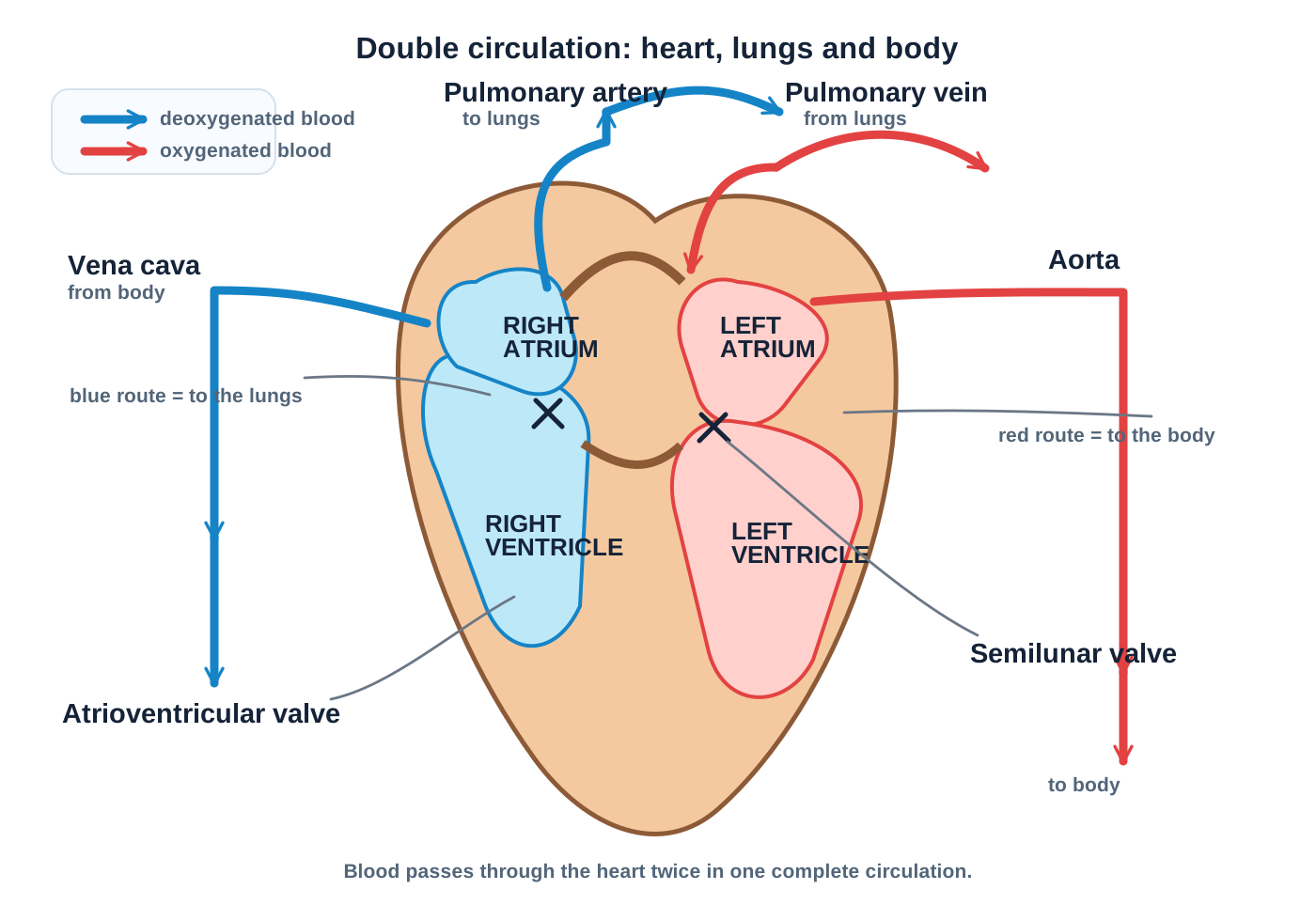
Haemoglobin loads oxygen where partial pressure is high and unloads it where it is low. Its sigmoid dissociation curve reflects cooperative binding. The heart acts as a double pump: atrial systole fills ventricles, ventricular systole raises pressure and valves prevent backflow. Coronary arteries supply cardiac muscle itself.
Atherosclerosis narrows arteries when fatty plaques form in damaged endothelium. A clot can produce a myocardial infarction if coronary flow is blocked. Risk factors can be non-modifiable, such as age and inherited alleles, or modifiable, such as smoking, hypertension, diet and inactivity. An exam evaluation should distinguish an observed association from a proven mechanism.
Mass transport, treatment and obesity
A mass-transport system is needed when diffusion distances are too large. Arteries carry blood away from the heart under high pressure, veins return it with valves and a large lumen, and capillaries have thin walls for exchange. Tissue fluid forms from plasma forced out at the arterial end of capillaries and returns by osmosis and the lymphatic system.
CVD treatment can reduce risk through lifestyle change, statins, antihypertensive drugs, angioplasty, stents or bypass surgery. Compare mechanisms, side effects, suitability and cost. Body mass index is mass divided by height squared; it is a screening indicator, not a direct measurement of body-fat distribution or health.
Active recall checkpoint
2Membranes, Proteins, DNA and Gene Expression
Exchange and membranes
Gas-exchange surfaces combine large area, short diffusion distance and maintained gradients. Phospholipid bilayers are selectively permeable; channels, carriers and pumps control movement. Osmosis depends on water potential.
Lung ventilation and blood flow maintain alveolar gradients. Smoking damages cilia, alveoli and cardiovascular function.
Proteins and genetic information
Primary amino-acid sequence determines protein folding and function. DNA base sequence is transcribed to mRNA and translated at ribosomes. Mutation can alter a codon, amino-acid sequence and phenotype.
Alleles segregate in meiosis and combine at fertilisation. Genetic diagrams should define symbols, show gametes and report a probability or ratio.
Gene expression and testing
Gene expression changes through transcription control and cell differentiation. Modern tests use DNA amplification, probes and electrophoresis. Results have probabilistic limits and require careful communication.
Exchange surfaces and Fick's law
Effective exchange surfaces have a large surface area, short diffusion pathway and a steep concentration gradient. In the lung, many alveoli, thin epithelium, moist lining, dense capillary network and ventilation all sustain diffusion. Smoking can damage cilia and alveolar walls, reducing gas-exchange efficiency.
Membrane transport
The fluid-mosaic model contains a phospholipid bilayer, cholesterol, proteins and carbohydrate-containing glycoproteins or glycolipids. Small non-polar molecules diffuse through the bilayer; ions and polar solutes use channel or carrier proteins. Facilitated diffusion is passive, whereas active transport uses ATP to move solutes against a gradient.
Osmosis is net water movement across a partially permeable membrane from higher to lower water potential. Animal cells may burst or crenate in extreme solutions; plant cells become turgid or plasmolysed because of their cellulose walls.
DNA, protein synthesis and inheritance
DNA has antiparallel polynucleotide strands held by complementary base pairing: A with T and C with G. Semi-conservative replication produces two molecules with one original and one new strand. During transcription, a gene is copied into mRNA; translation at a ribosome uses tRNA anticodons to assemble a polypeptide.
A gene is a base sequence that can code for a polypeptide or functional RNA. Different alleles can be dominant, recessive, codominant or sex-linked. Genetic diagrams require a clear key, parental genotypes, gametes and a numerical probability; phenotype may also be modified by environment.
Mutations, disorders and screening
A substitution may be silent, missense or nonsense; an insertion or deletion can cause a frameshift. Mutations arise spontaneously or through mutagens, and their effect depends on where they occur. Genetic disorders may be caused by a single altered gene, chromosome changes or a combination of alleles and environment.
Genetic screening can identify carriers, affected embryos or susceptibility alleles. Benefits include informed decisions and earlier monitoring; limitations include false results, uncertain predictions, anxiety, discrimination, consent and protection of genetic data.
Active recall checkpoint
3Cell Structure, Reproduction and Development
Cell structure and imaging
Organelles compartmentalise eukaryotic cells. Prokaryotes lack membrane-bound organelles. Electron microscopes provide higher resolution than light microscopes; staining and sectioning create contrast but may introduce artefacts.
Cell division and reproduction
Mitosis produces genetically identical nuclei for growth and repair. Meiosis halves chromosome number and produces variation through crossing over and independent assortment. Fertilisation restores diploid number.
Gamete structure supports function: sperm are motile and enzyme-equipped; eggs contain resources and surface mechanisms that reduce polyspermy.
Development and stem cells
Early cells differentiate through selective gene expression. Stem-cell potency describes the range of cell types a cell can produce. Medical uses must be weighed against rejection, tumour risk, delivery and ethics.
Cell organisation and ultrastructure
Cells form tissues, tissues form organs and organs work in systems. Eukaryotic cells have membrane-bound organelles; prokaryotic cells do not. Nuclei contain chromosomes, rough endoplasmic reticulum and ribosomes synthesise proteins, Golgi apparatus modifies and packages them, mitochondria supply ATP and lysosomes contain hydrolytic enzymes.
Plant cells also have a cellulose wall, chloroplasts and a large permanent vacuole. Specialised cells differ because they express different genes and therefore make different proteins. Link each adaptation to its functional advantage rather than merely naming the organelle.
Microscopy and measurement
Magnification is image size divided by actual size. Resolution is the minimum separation at which two points can still be distinguished; electron microscopy has greater resolution than light microscopy but cannot usually observe living specimens. A scale bar is more useful than only reporting magnification because images may be resized.
Prepare slides as thinly as possible, use stains only where useful and begin with low power. A biological drawing uses clear single outlines, proportionate size, label lines that do not cross and a title. Do not add texture or structures that are not visible.
Mitosis, meiosis and fertilisation
Before division, DNA replicates. Mitosis makes two genetically identical diploid nuclei for growth, repair and asexual reproduction. Meiosis has two divisions and makes four genetically varied haploid cells. Crossing over and independent assortment create new allele combinations.
Fertilisation combines two haploid gametes and restores diploid chromosome number. Sperm are adapted for motility, acrosome enzyme release and haploid delivery; egg cells provide a large cytoplasm and mechanisms that limit polyspermy.
Stem cells, specialisation and epigenetics
Stem cells are unspecialised cells capable of division and differentiation. Embryonic stem cells have broader developmental potential than adult tissue stem cells. Possible treatments must be evaluated for rejection, uncontrolled growth, tissue integration, long-term evidence, consent and ethics.
Epigenetic modification changes gene expression without altering the base sequence. DNA methylation and histone modification can make genes less or more accessible to transcription. Environment and development can influence epigenetic patterns, but avoid implying that every environmentally linked trait is inherited unchanged.
Active recall checkpoint
4Plant Structure, Biodiversity and Conservation
Plant structure and transport
Cellulose microfibrils provide tensile strength. Xylem vessels are lignified and hollow; phloem sieve tubes and companion cells translocate assimilates. Water moves through roots and leaves down water-potential gradients and up xylem by cohesion-tension.
Stomata balance carbon-dioxide entry against water loss. Light, temperature, humidity and air movement affect transpiration.
Biodiversity and classification
Biodiversity includes genetic, species and ecosystem diversity. Classification organises organisms; molecular evidence refines evolutionary relationships. Random quadrats estimate abundance and transects reveal distribution along gradients.
Conservation
Habitat loss, overexploitation, pollution, invasive species and climate change reduce diversity. In situ methods preserve ecological interactions; ex situ methods protect genetic material or small populations.
Plant cells, tissues and transport
Cellulose forms microfibrils that strengthen cell walls. Xylem vessels are dead, lignified and hollow so they withstand tension while moving water and mineral ions. Phloem sieve-tube elements transport sucrose and amino acids; companion cells supply ATP for loading and unloading.
Transpiration is evaporation from mesophyll followed by diffusion through stomata. Cohesion between water molecules and adhesion to xylem walls maintain a transpiration stream. Guard cells alter stomatal aperture as their solute concentration changes, balancing carbon dioxide entry against water loss.
Classification and evolution
Classification places organisms into hierarchical groups. Species are normally able to interbreed and produce fertile offspring, although this definition has limits for asexual organisms. Molecular comparisons of DNA or proteins can reveal evolutionary relationships and can lead to reclassification.
Biodiversity can be genetic, species or ecosystem diversity. A higher species count alone does not guarantee greater diversity; relative abundance matters too. Conservation strategies should retain genetic variation as well as protect individual species.
Sampling and ecological data
Use random quadrats when estimating abundance over a uniform area and transects when a variable changes along a gradient. Frequency records presence, density gives organisms per unit area and percentage cover estimates area occupied. Decide the sampling method before collecting data to avoid bias.
A valid field investigation has a defined population, enough independent samples, consistent identification and calibrated abiotic measurements. Explain whether a pattern is reliable, then suggest a mechanism without claiming proof where uncontrolled variables remain.
Bacteria, drugs and ecosystems
Bacteria reproduce by binary fission and can grow rapidly when nutrients, temperature, pH and oxygen availability are suitable. Batch and continuous culture have different advantages, but both need sterile technique and controlled conditions. In biotechnology, bacterial cells can produce useful compounds when growth conditions are monitored.
Drug development moves from laboratory screening through cell and animal studies to phased clinical trials. Placebo controls, random allocation, double blinding and sufficient sample size help separate a drug effect from bias or natural variation. An ecosystem contains interacting communities and abiotic conditions; change to one component can alter populations through food webs and nutrient cycles.