← Hub
9701 Chemistry — Ultimate
...
Ready
These notes are AI-assisted study material. Always cross-check against the official 9701 syllabus or your teacher before relying on them in an exam.

9701 AS Level Chemistry

AS Notes — Cambridge International (2025-2027)
Authors: Amber Ruan, Yuchen Wang
Paper 1 — MCQ Paper 2 — Structured Paper 3 — Practical 22 Topics

1Atomic Structure

Sub-atomic particles, isotopes, electron configuration in shells/sub-shells/orbitals, and trends in ionisation energy.

1.1 Sub-atomic Particles

ParticleRelative chargeRelative mass
Proton+11
Neutron01
Electron−11/1836

Atomic number Z = number of protons. Mass number A = protons + neutrons.

Isotopes: atoms of the same element with the same number of protons but different numbers of neutrons. Same chemical properties (same electron configuration); different physical properties (different mass and density).

1.2 Electron Sub-shells and Orbitals

  • Shells n = 1, 2, 3° subdivided into s, p, d sub-shells.
  • s sub-shell: 1 orbital, max 2 electrons. p sub-shell: 3 orbitals, max 6 e. d sub-shell: 5 orbitals, max 10 e.
  • Energy order: 1s < 2s < 2p < 3s < 3p < 4s < 3d < 4p.
  • Hund's rule: electrons occupy degenerate orbitals singly before pairing.
  • Pauli exclusion: max 2 e per orbital, opposite spins.
Cr is [Ar] 3d5 4s1 and Cu is [Ar] 3d10 4s1 — exceptions for extra stability of half-filled / full d sub-shell.

1.3 Shapes of s and p Orbitals

The s orbital is spherical; the p orbital is dumb-bell shaped, with three orientations along x, y, z axes.
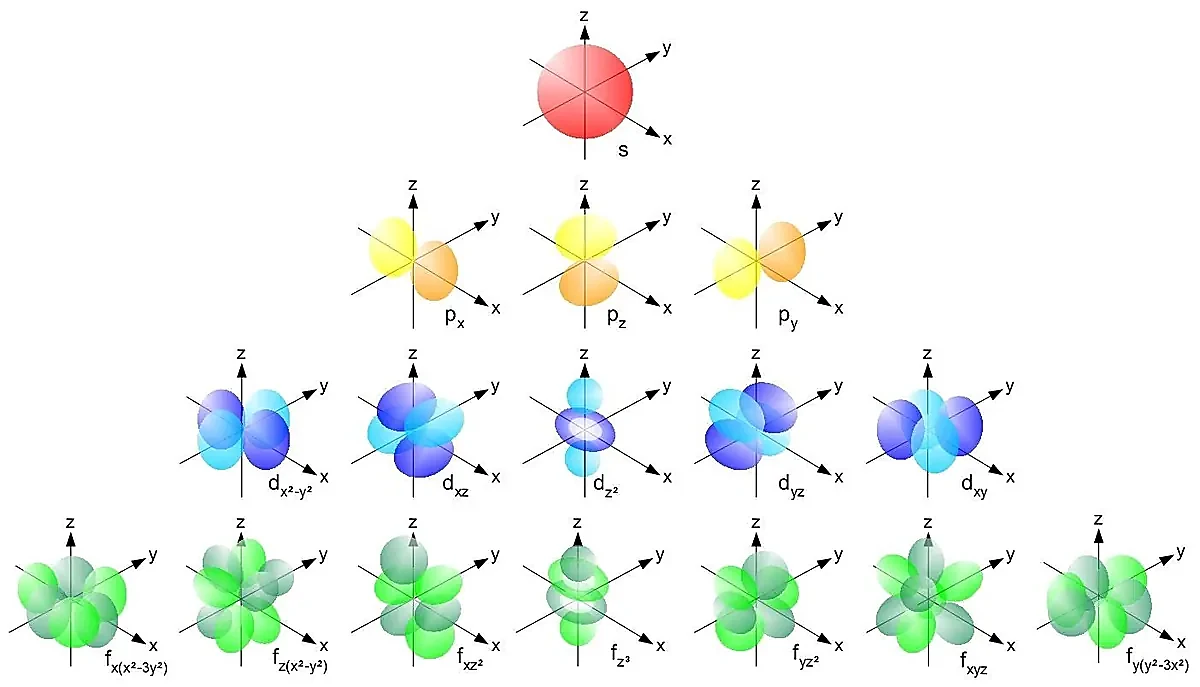
Shapes and orientations of s, p and d atomic orbitals
Atomic-orbital shapes and orientations. Use the p-orbital row to distinguish px, py and pz; click the diagram to enlarge.

1.4 Ionisation Energy

First IE: energy required to remove one electron from each atom in one mole of gaseous atoms to form one mole of gaseous 1+ ions. X(g) → X+(g) + e

Trends:

  • ↑ across a period — nuclear charge increases, atomic radius decreases, shielding roughly constant.
  • ↓ down a group — extra shell increases atomic radius and shielding, outweighs ↑ nuclear charge.
  • Dip at Group 13 (e.g. Al < Mg) — the electron removed is from 3p, less penetrating than 3s.
  • Dip at Group 16 (e.g. S < P) — spin-pair repulsion in doubly-occupied p orbital.

Successive IEs always increase. A large jump reveals movement to an inner shell — used to identify the group.

Worked example
Successive IEs of an element (kJ mol−1): 738, 1451, 7733, 10 540. The big jump between IE2 and IE3 means there are only 2 electrons in the outer shell — element is in Group 2.

1.5 Atomic and Ionic Radius Trends

Atomic radius decreases across a period (same shell, increasing nuclear charge) and increases down a group (new shell, more shielding). A cation is smaller than its atom; an anion is larger. A beam of protons is deflected towards the negative plate, electrons more strongly the other way (larger charge/mass), neutrons not at all.

1.6 Writing Ionisation-Energy Equations

First IE: X(g) → X+(g) + e. Second IE starts from the ion: X+(g) → X2+(g) + e. Use successive IE jumps to deduce the group and the electronic configuration.

2Atoms, Molecules and Stoichiometry

The mole concept, relative masses, empirical and molecular formulae, and calculation of reacting quantities.

2.1 Key Definitions

Mole: the amount of substance that contains as many particles as there are atoms in 12 g of carbon-12. L = 6.022 × 10²³ mol−1.
Relative atomic mass Ar: weighted mean mass of an atom of an element, relative to 1/12 of the mass of a 12C atom.
Empirical formula: simplest whole-number ratio of atoms. Molecular formula: the actual number of atoms in a molecule.

2.2 Mole Calculations

moles n = mass / Mr
Solutionsmoles = concentration × volume / 1000  (if V is in cm3)
Gasesn = V / 24.0 dm3  (room conditions); V / 22.4 dm3 at s.t.p.
pV = nRT  (R = 8.31 J K−1 mol−1)
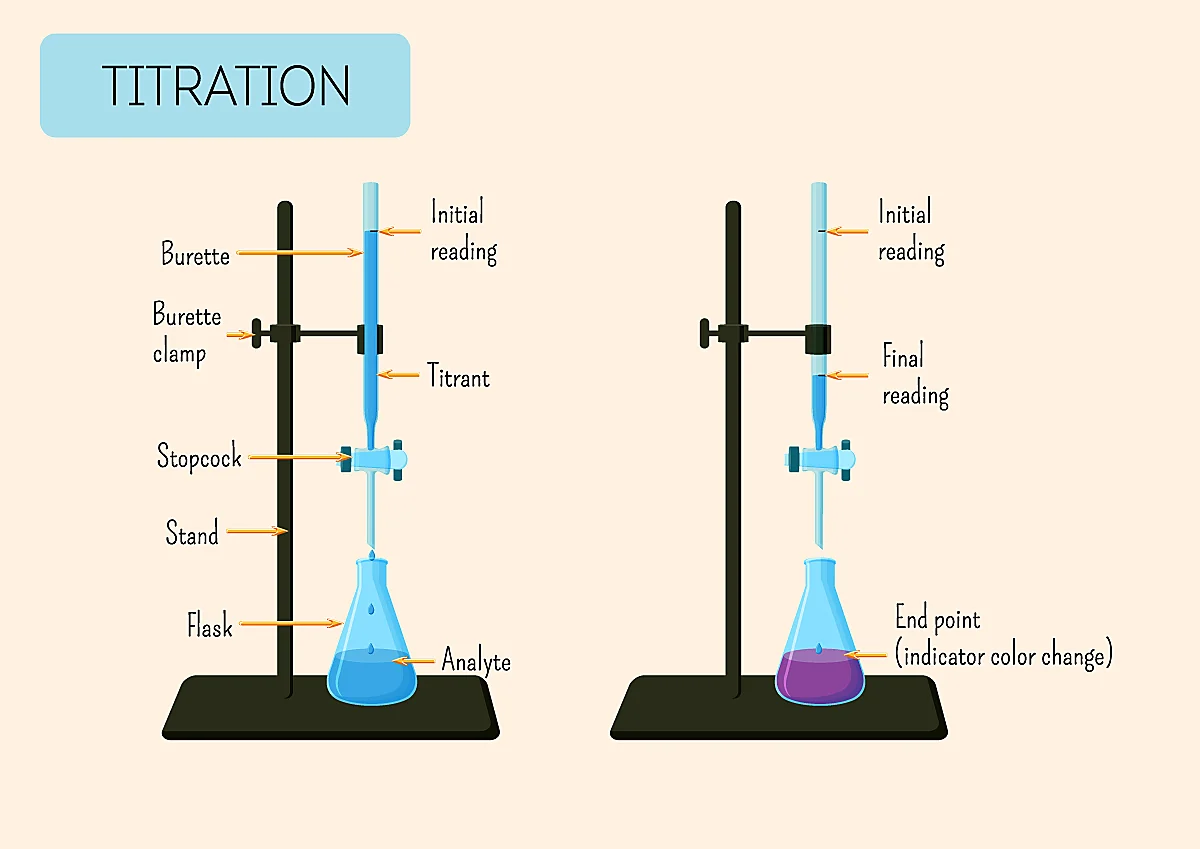
Titration apparatus showing initial and final burette readings and the colour change at the end point
Read the burette at eye level before and after titration; the titre is final reading minus initial reading, and the end point is the first permanent indicator colour change.

2.3 Yield and Limiting Reagent

% yield = (actual moles / theoretical moles) × 100%

Identify the limiting reagent by comparing mole ratios from the balanced equation; the one that gives the smallest product amount is limiting.

2.4 Ionic Equations

Spectator ions (those unchanged on both sides) are omitted. Atoms and charge must balance.

Example
Full: AgNO3 + NaCl → AgCl + NaNO3
Ionic: Ag+ + Cl → AgCl(s)

2.5 Common Ions to Memorise

NH4+, OH, NO3, CO32−, HCO3, SO42−, PO43−, MnO4, Cr2O72−, Ag+, Zn2+, Pb2+.

2.6 Definitions You Must State

  • Unified atomic mass unit: 1/12 of the mass of one 12C atom.
  • Ar, relative isotopic mass, Mr and relative formula mass are all measured on that scale.
  • One mole contains L = 6.02×10²³ specified particles.
  • Empirical formula is the simplest whole-number ratio; molecular formula is a whole-number multiple of it.
  • Hydrated salts contain water of crystallisation; anhydrous salts do not.

Mole calculations must cover reacting masses, gas volumes (24.0 dm3 mol−1 at r.t.p. if given), solution concentrations, percentage yield and limiting reagent. Always use state symbols in ionic equations and omit spectators.

3Chemical Bonding

Electronegativity, ionic/covalent/metallic bonding, VSEPR shapes, and intermolecular forces (including hydrogen bonding).

3.1 Electronegativity

Electronegativity: the power of an atom in a covalent bond to attract the shared pair of electrons to itself.

Increases across a period (↑ nuclear charge, ↓ radius); decreases down a group (↑ radius, more shielding). Large difference → ionic; small/zero → covalent. F is the most electronegative element.

3.2 Ionic Bonding

Ionic bond: the electrostatic attraction between oppositely charged ions formed by electron transfer.

Examples: NaCl, MgO, CaF2. Large difference in electronegativity required (typically > 1.7).

3.3 Covalent and Coordinate Bonding

Covalent bond: the electrostatic attraction between the nuclei of two atoms and the shared pair of electrons between them.
  • σ bond: head-on orbital overlap; first bond in a pair.
  • π bond: sideways overlap of adjacent p orbitals; second/third bond in C=C, C≡C, C=O.
  • Coordinate (dative) bond: both electrons supplied by one atom (e.g. NH4+, Al2Cl6, NH3→BF3). Identical in strength once formed.
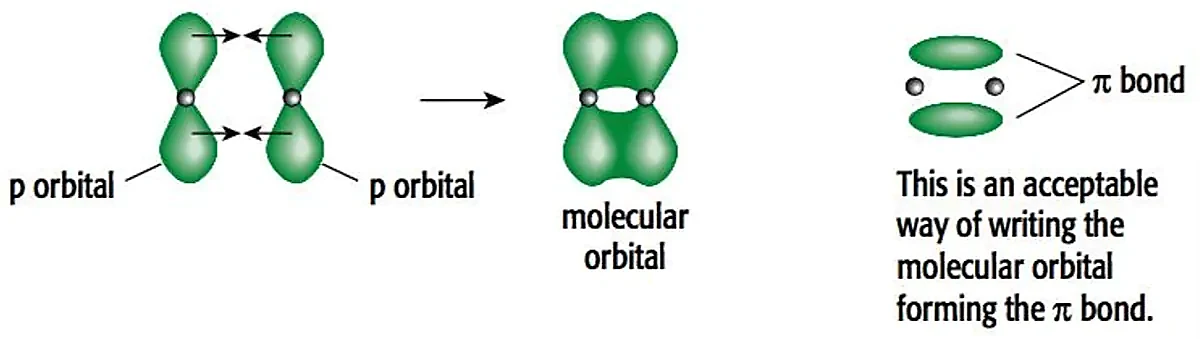
Sideways overlap of p orbitals forming a pi bond
A π bond forms by sideways overlap of adjacent p orbitals, leaving electron density above and below the internuclear axis.

Period 3 and below can expand the octet (use d orbitals), giving SO3, PCl5, SF6.

3.4 Metallic Bonding

Metallic bond: the electrostatic attraction between the lattice of positive metal ions and the delocalised sea of electrons.

Explains malleability, ductility, high mp/bp and electrical conductivity.
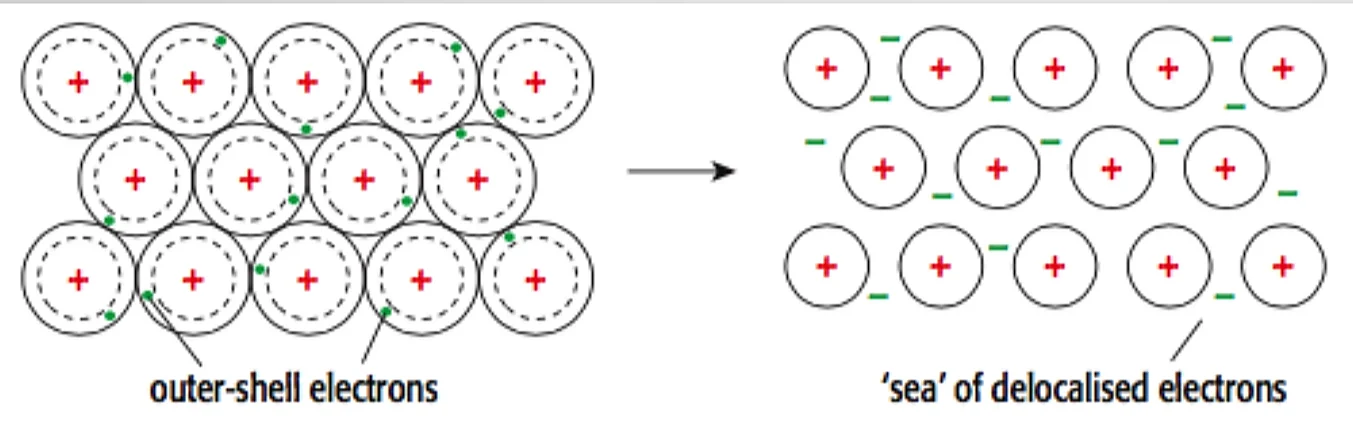
Positive metal ions surrounded by a sea of delocalised outer-shell electrons
Metallic bonding is non-directional: positive ions are held together by attraction to mobile delocalised electrons, which also carry charge through the lattice.

3.5 VSEPR Shapes

MoleculeShapeBond angle
BF3Trigonal planar120°
CO2Linear180°
CH4Tetrahedral109.5°
NH3Pyramidal107°
H2OBent / non-linear104.5°
PF5Trigonal bipyramidal90° & 120°
SF6Octahedral90°

Lone pairs repel more than bonding pairs — reduce bond angle (NH3 107°, H2O 104.5°).

3.6 Intermolecular Forces

  • id-id (induced dipole - induced dipole / London): present in all molecules; strength ↑ with electron count / surface area.
  • pd-pd (permanent dipole - permanent dipole): between polar molecules with net dipole moment.
  • Hydrogen bonding: H bonded to N, O or F + lone pair on N/O/F of another molecule. Strongest intermolecular force.
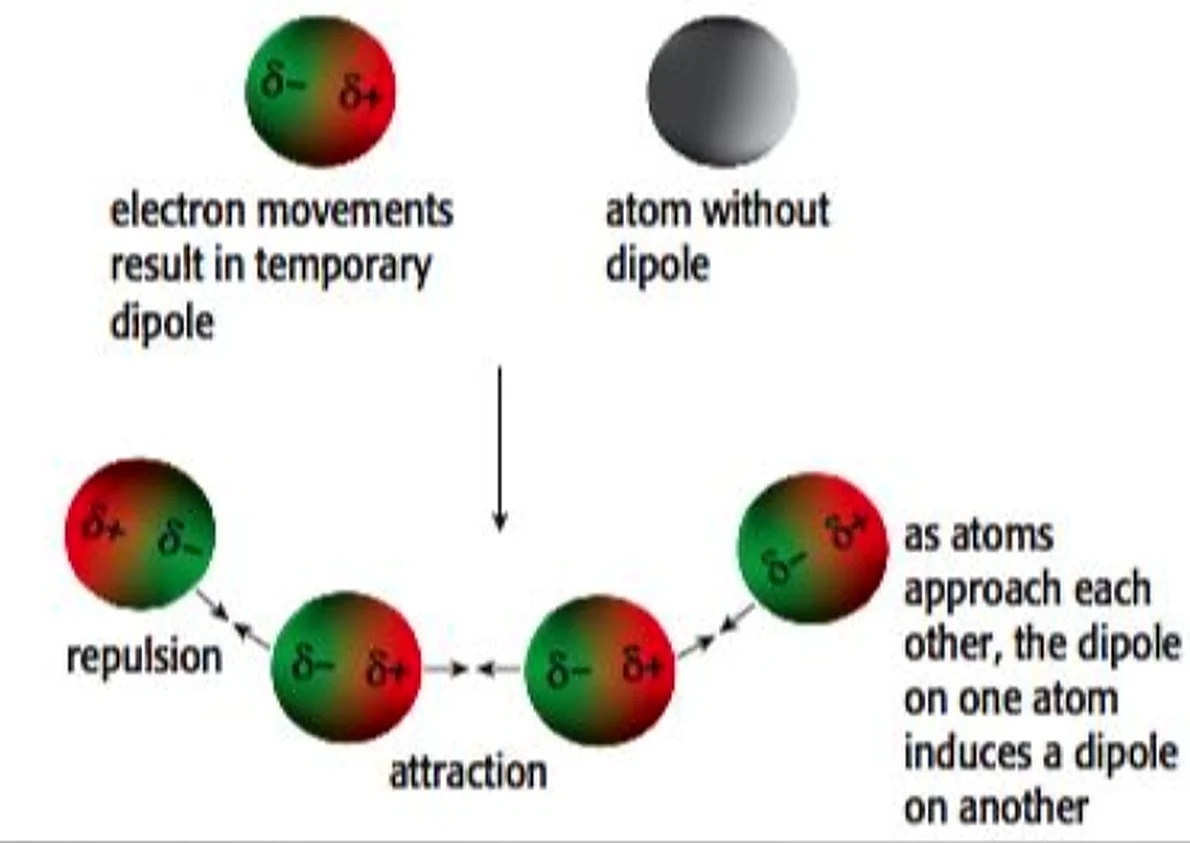
An instantaneous dipole inducing a dipole in a neighbouring atom and producing attraction
Random electron movement creates an instantaneous dipole; it induces an opposite dipole nearby, so the two particles attract temporarily.
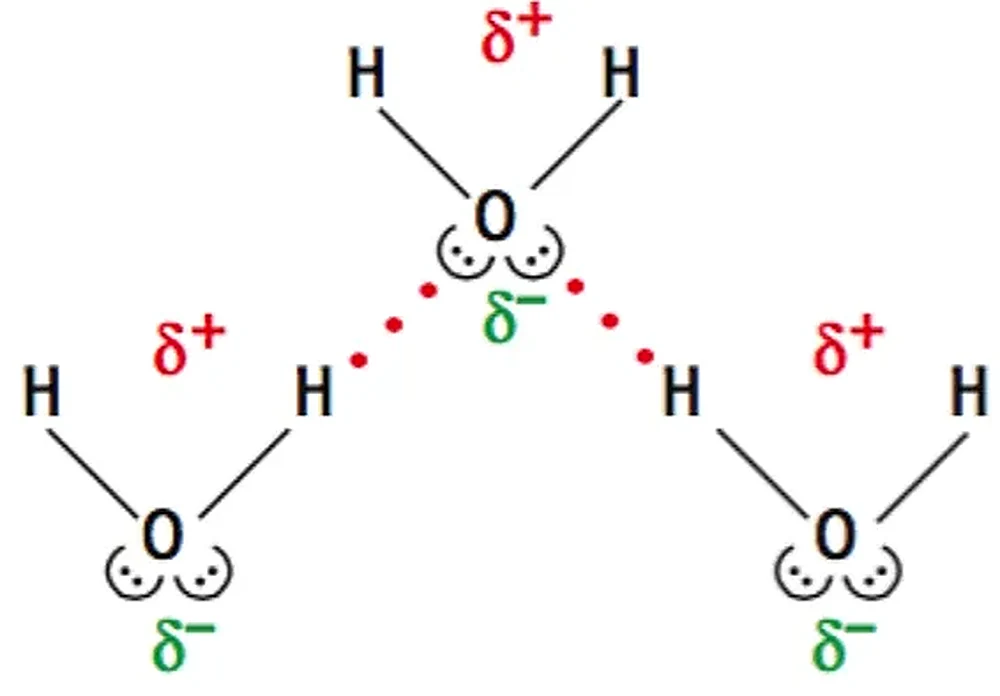
Hydrogen bonding between three polar water molecules
Hydrogen bonds form between a δ+ hydrogen on one molecule and a lone pair on an electronegative atom of another molecule.
H bonding explains why ice is less dense than water (open tetrahedral lattice), and the high bp of H2O, NH3 and HF compared to other Group 16/15/17 hydrides.
Common mistake: calling H-bond "an actual bond between molecules". Be precise: it is an intermolecular force, weaker than a covalent bond but stronger than other intermolecular forces.

3.7 σ and π Bonds; Hybridisation

A σ bond is end-on overlap of orbitals on the internuclear axis. A π bond is sideways overlap of p orbitals. H2 is σ only; C2H4 is one σ + one π; N2 and HCN have a triple bond (one σ + two π).

sp3 (tetrahedral, 109.5°) in CH4 and C2H6; sp2 (120°) in C2H4; sp (180°) in HCN and C2H2.

3.8 Expanded Octet and Dative Bonds

Period 3 can expand the octet: SO2, PCl5, SF6. A dative (coordinate) bond is a shared pair provided by one atom: NH3 + HCl → NH4+; Al2Cl6 is two AlCl3 units linked by dative bonds from Cl to Al.

4States of Matter

Ideal gas behaviour and the four lattice types (ionic, simple molecular, giant covalent, metallic).

4.1 The Ideal Gas

pV = nRT

Assumptions: negligible molecular volume, no intermolecular forces, elastic collisions, random motion. Real gases deviate at high pressure / low temperature.

4.2 Lattice Types

TypeExamplemp/bpConductivity
Giant ionicNaCl, MgOHighOnly molten/aqueous
Simple molecularI2, C60, iceLowNone
Giant covalentSiO2, diamond, graphiteVery highNone (graphite conducts)
Giant metallicCu, MgHighSolid & molten
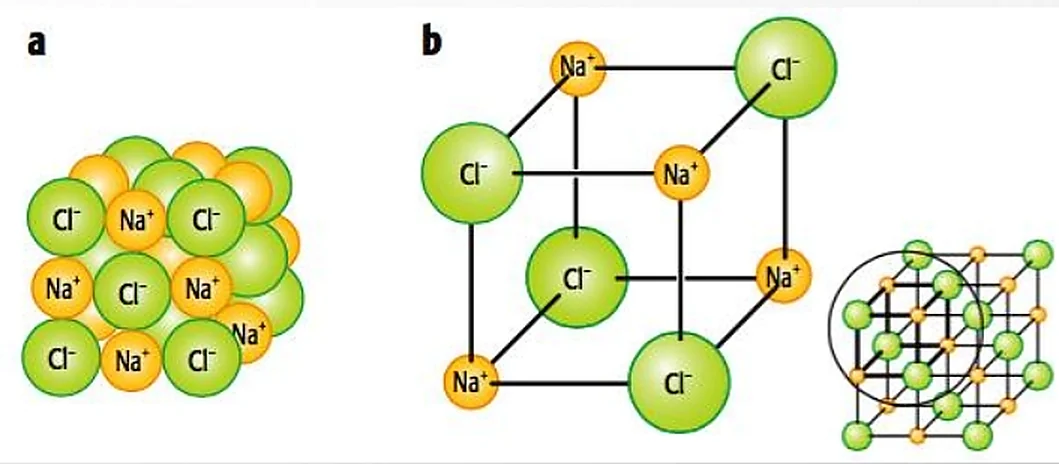
Three representations of alternating sodium and chloride ions in a giant ionic lattice
A giant ionic lattice extends in three dimensions. Each ion is surrounded by oppositely charged ions, producing strong electrostatic attraction throughout the crystal.
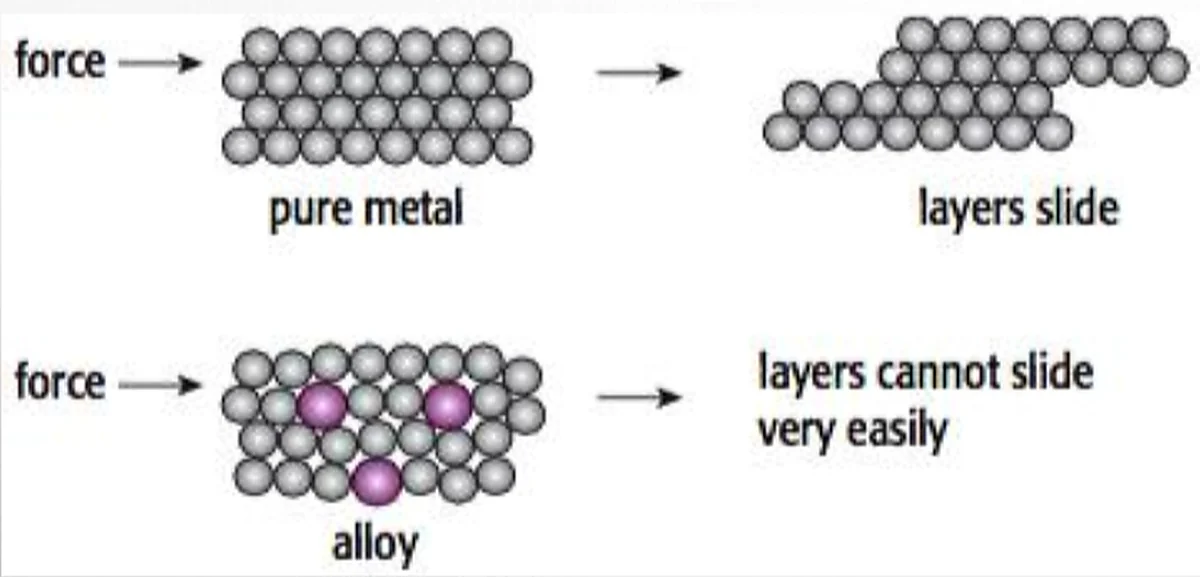
Regular layers sliding in a pure metal compared with distorted layers in an alloy
Equal-sized atoms in a pure metal form layers that slide readily. Different-sized atoms in an alloy disrupt the layers, making sliding harder and the material stronger.

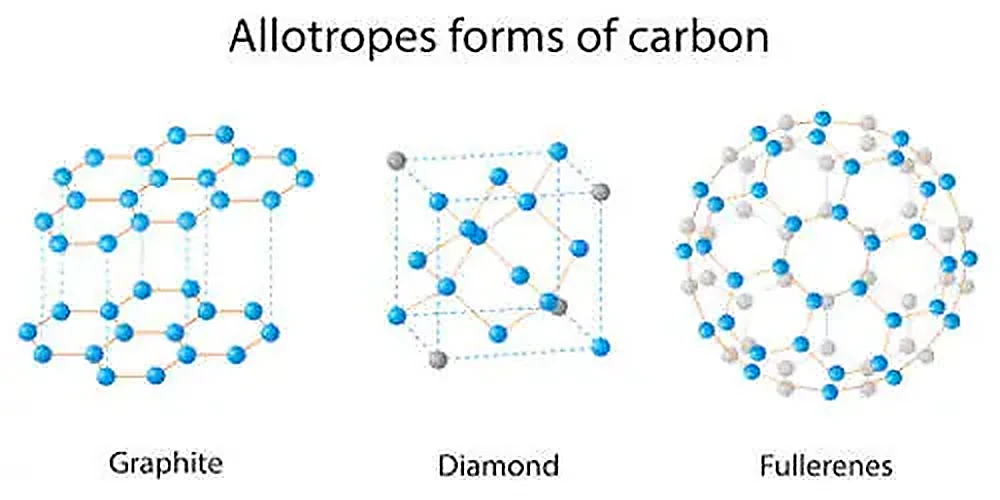
4.3 Allotropes of Carbon

Structures of graphite, diamond and fullerene
Graphite, diamond and fullerene contain only carbon but differ in bonding and structure, producing very different physical properties.
  • Diamond: sp3, four σ C-C bonds per atom, tetrahedral. Very hard, non-conductor.
  • Graphite: sp2, layers of hexagonal rings; delocalised π electrons — conducts along layers; layers slide — lubricant.
  • Buckminsterfullerene (C...): simple molecular sphere; held by id-id forces; low mp.

4.4 Ideal and Real Gases

pV = nRT

Real gases deviate at high pressure (finite molecular volume) and low temperature (intermolecular attractions). They behave most ideally at low p and high T.

5Chemical Energetics (AS)

Enthalpy changes, standard definitions, calorimetry, Hess's law and bond energies.

5.1 Enthalpy Change ΔH

Exothermic: ΔH < 0 (heat released; products lower than reactants). Endothermic: ΔH > 0. Standard conditions: 298 K and 101 kPa, with substances in their standard states.
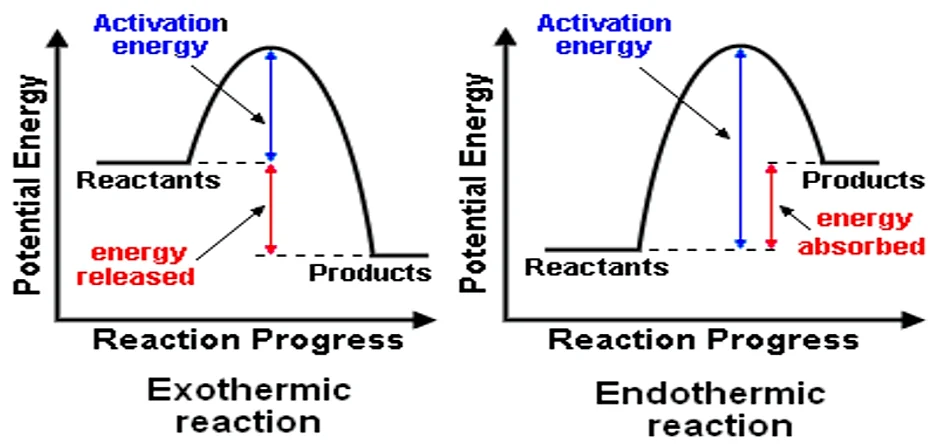
Potential energy profiles for exothermic and endothermic reactions with activation energy and enthalpy change marked
In both profiles the peak is the activation barrier. Products lie below reactants for an exothermic reaction and above them for an endothermic reaction.

5.2 Standard Enthalpy Definitions

ΔHf° (formation): enthalpy change when 1 mole of a compound is formed from its elements in their standard states under standard conditions.
ΔHc° (combustion): enthalpy change when 1 mole of a substance is completely burned in oxygen under standard conditions.
ΔHneut°: enthalpy change when 1 mole of water is formed by the neutralisation of an acid by an alkali under standard conditions.
ΔHr° (reaction): enthalpy change for a reaction as the equation is written under standard conditions.

5.3 Calorimetry

q = mcΔT  ⇒  ΔH = −mcΔT / n

c for water = 4.18 J g−1 K−1. The negative sign converts "heat absorbed by water" to "enthalpy released by reaction".
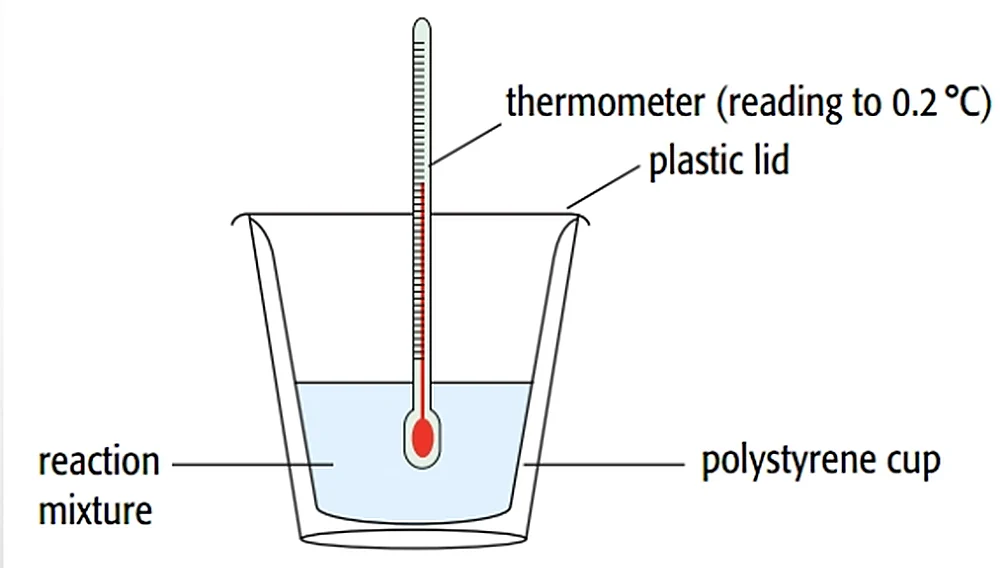
Insulated polystyrene cup calorimeter with lid and thermometer
A lidded polystyrene cup reduces heat exchange with the surroundings. Measure the largest temperature change and use the mass of solution in q = mcΔT.

5.4 Bond Energies

ΔH = Σ(bonds broken) − Σ(bonds formed)

Breaking bonds is endothermic (+); making bonds is exothermic (−). Bond energies are averages, so calculated ΔH is approximate (exact only for gaseous diatomics).

5.5 Hess's Law
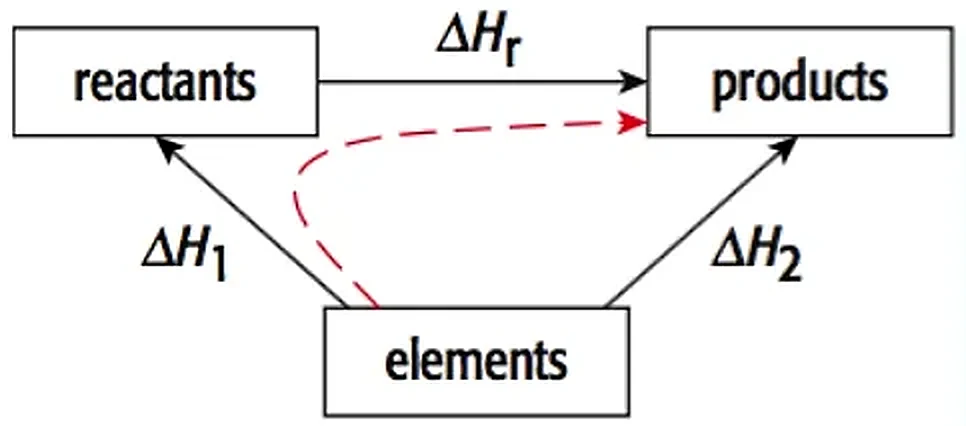
Hess's Law: the enthalpy change of a reaction is independent of the route, depending only on the initial and final states.
General Hess cycle linking reactants, products and elements
General Hess cycle: choose a common intermediate, keep arrow directions consistent, and apply the algebraic sign of each route.
Using ΔHf: ΔHr = ΣΔHf(products) − ΣΔHf(reactants). Using ΔHc: ΔHr = ΣΔHc(reactants) − ΣΔHc(products) — opposite direction.

5.6 Calorimetry Equation and Standard Conditions

q = mcΔT   then   ΔH = ±q/n

Standard enthalpy changes refer to 101 kPa and a stated temperature, usually 298 K, with standard states. Exothermic ΔH is negative. Average bond energy is the mean enthalpy to break one mole of that bond in the gaseous state.

6Electrochemistry (AS)

Redox language, oxidation numbers, oxidising and reducing agents, and balancing half-equations.

6.1 Redox Definitions

Oxidation: loss of electrons / increase in oxidation number. Reduction: gain of electrons / decrease in oxidation number. OIL RIG.

The two always occur together. Older criteria (gain/loss of oxygen or hydrogen) agree with the oxidation-number test when all four can be applied; the oxidation-number test is the one examiners expect.

Disproportionation: the same element is oxidised and reduced in one reaction (Cl2 + cold dilute NaOH). Comproportionation is the reverse: two different oxidation states of one element meet at an intermediate state.

6.2 Oxidation Number Rules

  • Uncombined element (including O2, Cl2, S8): 0.
  • Group 1 in compounds: +1. Group 2: +2. F: always −1.
  • O: usually −2; peroxides −1; OF2 +2.
  • H: usually +1; metal hydrides (NaH) −1.
  • Monoatomic ion: charge on the ion.
  • Sum in a neutral compound is 0; sum in a polyatomic ion equals the ion charge.
  • The more electronegative atom takes the negative number.

Use Stock names: iron(II) chloride is FeCl2; chlorate(I) is ClO; nitrate(V) is NO3; manganate(VII) is MnO4. Everyday “nitrate” means nitrate(V).

6.3 Oxidising and Reducing Agents

An oxidising agent accepts electrons and is itself reduced (MnO4/H+, Cr2O72−/H+, Cl2, conc. H2SO4, O2). A reducing agent donates electrons and is itself oxidised (I, Fe2+, H2, C, reactive metals, SO2).

H2O2 is in the intermediate O(−1) state: it oxidises when oxygen goes to −2 (extra water formed) and reduces when O2 is produced.

Worked example
MnO4 + 5Fe2+ + 8H+ → Mn2+ + 5Fe3+ + 4H2O.
Mn +7 → +2 (reduced; MnO4 is the oxidant). Fe +2 → +3 (oxidised; Fe2+ is the reductant). The titration is self-indicating: first permanent pale pink is the end-point.

6.4 Balancing Redox Equations

Use this order in acid: balance the redox element; add H2O for O; add H+ for H; add e for charge; multiply halves so electrons cancel; never leave free electrons in the overall equation.

  1. MnO4 → Mn2+ needs 4H2O on the right, 8H+ on the left, then 5e on the left.
  2. Fe2+ → Fe3+ + e. Multiply by 5 and add.
  3. Check atoms and total charge on both sides.

In alkali, add OH to both sides to convert leftover H+ into water. Concentrated H2SO4 oxidises Br to Br2 and is reduced to SO2 — so it cannot be used to dry HBr.

7Equilibria (AS)

Dynamic equilibrium, Le Chatelier's principle, Kc and Kp, Brønsted-Lowry acids and bases, and industrial processes.

7.1 Dynamic Equilibrium

Forward and reverse rates equal; concentrations of all species constant; requires a closed system. Approached from either side.
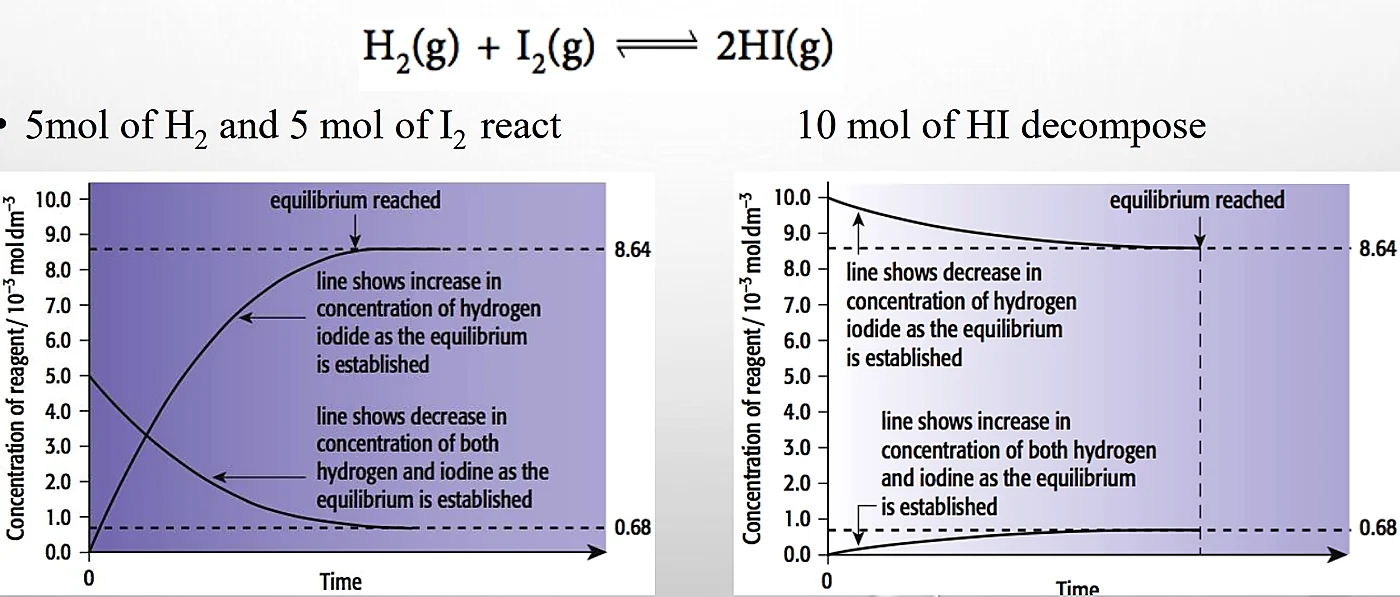
Concentration-time graphs showing the same equilibrium reached from reactants or from products
The final equilibrium composition is the same whichever side is used initially. Concentrations become constant, but both forward and reverse reactions continue at equal rates.

7.2 Le Chatelier's Principle

When a system at equilibrium is disturbed, it shifts in the direction that minimises the disturbance.
DisturbancePosition shifts to…
↑ reactant concentrationproducts (right)
↑ temperatureendothermic side
↑ pressureside with fewer moles of gas
Catalystno shift; equilibrium reached faster

7.3 Kc and Kp

For aA + bB ⇌ cC + dD:

Kc = [C]c[D]d / ([A]a[B]b)
Kp = (pCc×pDd) / (pAa×pBb)  (partial pressures)

Partial pressure: p = mole fraction × total pressure. Only temperature changes K. Solids and pure liquids are omitted.

7.4 Brønsted-Lowry Acids and Bases

Acid: a proton (H+) donor. Base: a proton acceptor.

Conjugate pairs differ by one H+. Strong acids/bases fully dissociate; weak ones partially. Indicator choice: pKa of indicator must lie in the vertical region of the titration curve.

7.5 Industrial Processes

  • Haber: N2 + 3H2 ⇌ 2NH3 (ΔH negative). Compromise 400 °C, 200 atm, Fe catalyst.
  • Contact: 2SO2 + O2 ⇌ 2SO3, V2O5, 450 °C, 1-2 atm.
Always state that conditions are a compromise between yield and rate.

7.6 Writing Kc and Kp

Kc uses equilibrium concentrations; Kp uses partial pressures (mole fraction × total pressure). Pure solids and liquids do not appear. K changes only with temperature. A catalyst does not change K — it shortens the time to reach the same position.

8Reaction Kinetics (AS)

Collision theory, activation energy, Boltzmann distributions, and effect of catalysts.

8.1 Collision Theory

Molecules must collide with energy ≥ Ea and the correct orientation.
Activation energy Ea: the minimum energy reacting particles must possess for a successful collision.
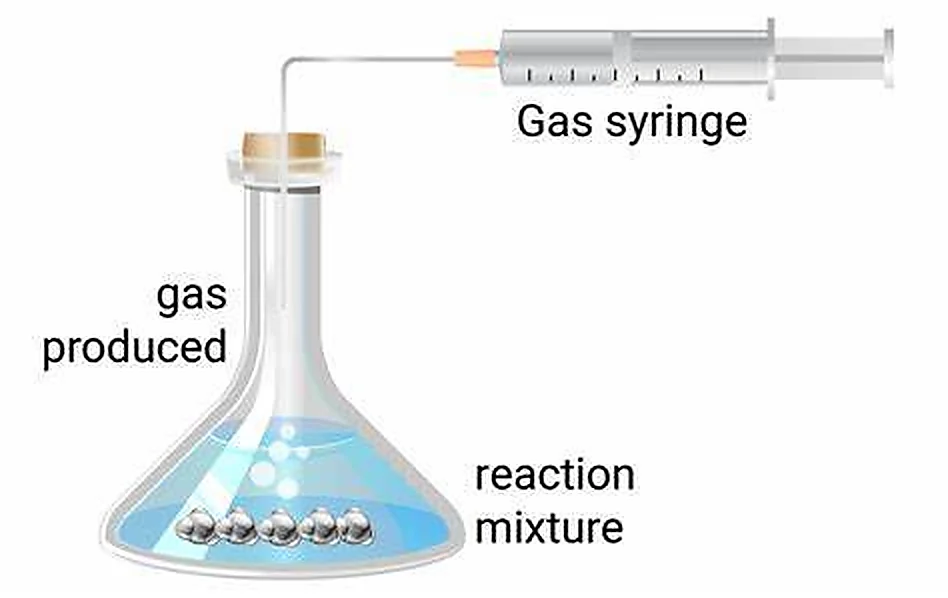
Reaction flask connected to a gas syringe for measuring gas volume against time
For a gas-producing reaction, record gas-syringe volume at regular times. The initial gradient of the volume-time graph gives the initial rate.

8.2 Boltzmann Distribution

Shows the distribution of molecular energies. Area to the right of Ea = fraction with enough energy.
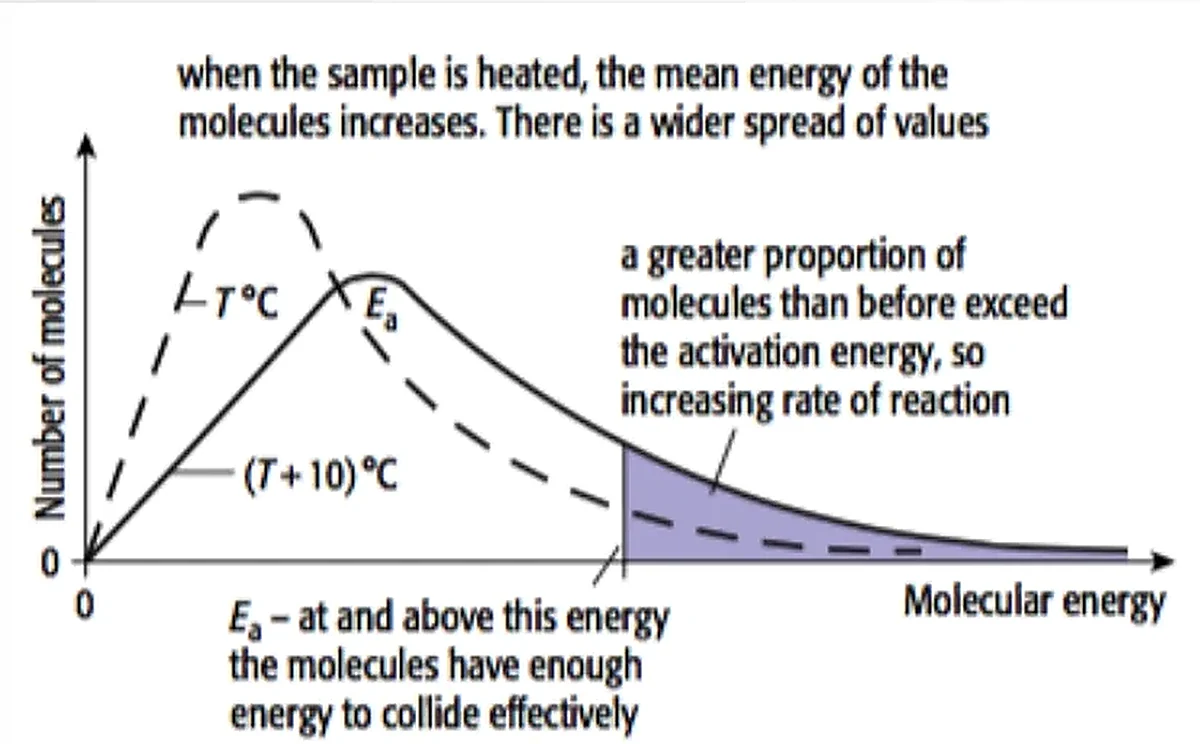
Boltzmann distributions at two temperatures with activation energy marked
Raising temperature lowers and broadens the distribution peak; the area to the right of Ea increases substantially.
  • Temperature: curve flattens and shifts right — much larger fraction exceeds Ea — rate increases sharply.
  • Concentration / pressure: more collisions per second.
  • Surface area: more sites for collision.
  • Catalyst: provides alternative pathway with lower Ea — larger fraction exceeds new Ea.
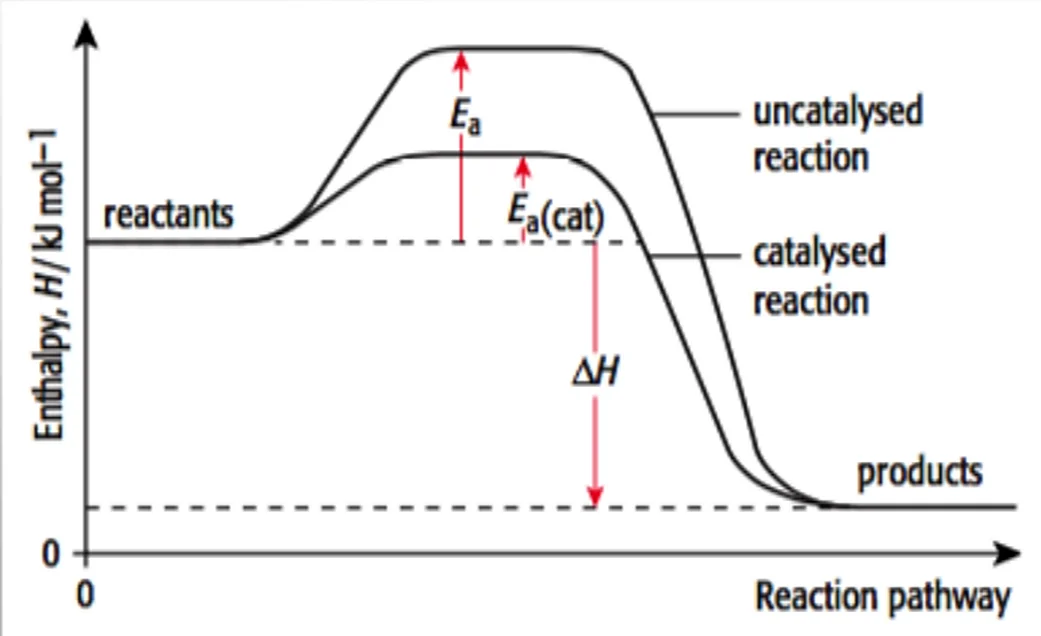
Catalysed and uncatalysed reaction pathways with different activation energies but the same enthalpy change
A catalyst lowers activation energy by providing another pathway. It does not change reactant or product energies, so ΔH and the equilibrium position are unchanged.
Common error: describing temperature effect as "molecules move faster so they collide more often" — this is true but minor. The dominant factor is the exponential increase in the fraction with E ≥ Ea.

8.3 Catalysts

A catalyst provides an alternative route with lower Ea. On a Boltzmann diagram, more molecules then exceed the new Ea. Draw the catalysed profile as a lower peak (sometimes two peaks if there is an intermediate). The catalyst is regenerated.

  • Homogeneous — same phase as the reactants (e.g. Fe2+/Fe3+ in I/S2O82−).
  • Heterogeneous — different phase, usually a solid surface (Haber Fe; Contact V2O5).

Rate is change of concentration per unit time. From a concentration–time graph, gradient at a point is the instantaneous rate; use initial rate for comparing conditions.

9Chemical Periodicity (Period 3)

Trends in Period 3: atomic radius, melting point, conductivity, and reactions of elements, oxides and chlorides.

9.1 Physical Trends Na → Ar

  • Atomic radius decreases (↑ nuclear charge, ~constant shielding).
  • Melting point: Na < Mg < Al (stronger metallic bond, more delocalised e); Si highest (giant covalent); then drop to simple molecular P4, S8, Cl2, Ar — S8 > P4 because of the larger molecule.
  • Electrical conductivity: Na < Mg < Al (more delocalised e); Si semiconductor; non-metals do not conduct.

9.2 Elements with Oxygen and Water

Na, Mg, Al — ionic oxides; Si — giant covalent oxide; P, S — simple molecular acidic oxides.

ElementOxide formulaReaction with waterpH
NaNa2ONa2O + H2O → 2NaOH~13
MgMgOSlow; Mg(OH)2 slightly soluble~9
AlAl2O3Insoluble; amphoteric~7
SiSiO2No reaction
PP4O10→ H3PO4~2
SSO2 / SO3→ H2SO3 / H2SO4<2

9.3 Period 3 Chlorides with Water

NaCl (neutral, dissolves); MgCl2 (slightly acidic); AlCl3 (acidic hydrolysis); SiCl4, PCl5 (vigorous hydrolysis — HCl fumes + acidic oxoacid).

SiCl4 + 2H2O → SiO2 + 4HCl

9.4 Period 3 Oxides and Chlorides

NaMgAlSiPS
OxideNa2OMgOAl2O3SiO2P4O10SO2/SO3
Bondingionicionicionic/covalentgiant covalentsimple covalentsimple covalent
Oxide + waterstrong alkaliweak alkaliinsolubleinsolublestrong acidstrong acid
Chloride + waterneutral pH~7slightly acidicacidic (fumes)acidicacidic

Al2O3 and Al(OH)3 are amphoteric: they dissolve in both acid and NaOH. Na and Mg react with water; later elements do not. Oxidation numbers of the oxides/chlorides match the number of valence electrons used.

10Group 2

Trends in reactivity, solubility of hydroxides and sulfates, and thermal stability of nitrates/carbonates.

10.1 Reactivity Trends Mg → Ba

Reactivity increases down the group because atomic radius increases, so the 2 outer electrons are more easily lost.

  • + O2 → MO (Ba forms peroxide BaO2).
  • + H2O → M(OH)2 + H2 (vigour increases down group; Mg slow with cold water, fast with steam → MgO).
  • + dilute acids → M2+ salt + H2.

10.2 Solubility Trends

CompoundTrend
Hydroxides M(OH)2Solubility increases Mg → Ba
Sulfates MSO4Solubility decreases Mg → Ba (BaSO4 insoluble — basis of sulfate test)

10.3 Thermal Stability

Stability of carbonates and nitrates increases down the group.

Explanation: larger cation has lower charge density — less polarising effect on the anion — harder to distort and decompose.

MgCO3 → MgO + CO2  |  2Mg(NO3)2 → 2MgO + 4NO2 + O2
2Ba(NO3)2 → 2Ba(NO2)2 + O2  (only Ba → nitrite formed, not oxide)

10.4 Reactions to Recall

Mg → Ba react with O2, water (Mg needs steam) and dilute HCl/H2SO4 to give H2. Oxides, hydroxides and carbonates all react with dilute acid to give a salt + water (+ CO2 from carbonates). Hydroxide solubility increases down the group; sulfate solubility decreases. Thermal stability of carbonates and nitrates increases down the group (larger cation, less polarising).

11Group 17 (Halogens)

Physical trends, oxidising/reducing ability, displacement reactions, and disproportionation of chlorine.

11.1 Physical Properties Cl2 → I2

  • Colour: Cl2 pale green gas, Br2 orange-brown liquid, I2 grey-black solid (purple vapour).
  • Volatility decreases down the group (stronger id-id forces as electron count increases).
  • Bond energy Cl-Cl > Br-Br > I-I (longer bond — weaker overlap).
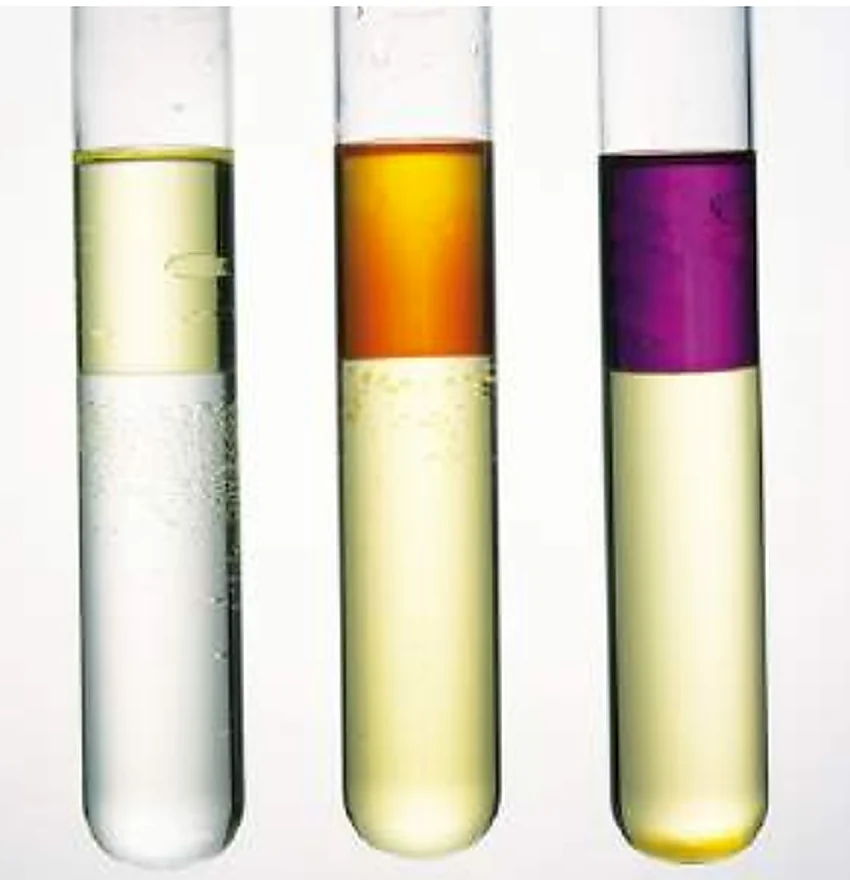
Halogen samples showing pale green chlorine, orange bromine and purple iodine colours
Halogen colours become deeper down Group 17: chlorine is pale green, bromine orange-brown and iodine gives a purple vapour.

11.2 Halogens as Oxidising Agents

Strength: Cl2 > Br2 > I2. Cl2 displaces Br2 and I2; Br2 displaces only I2.

Cl2 + 2KBr → 2KCl + Br2  (orange)

11.3 Halide Ions as Reducing Agents

Strength: I > Br > Cl. With conc. H2SO4:

  • NaCl + H2SO4 → NaHSO4 + HCl (steamy fumes; no further reduction).
  • NaBr → HBr; HBr reduces some H2SO4 → Br2 + SO2.
  • NaI → HI; HI reduces H2SO4 further → I2, then H2S, S (yellow solid, smell of rotten egg).

11.4 AgNO3 Test for Halides

HalideAgNO3 precipitateSolubility
ClWhiteSoluble in dilute NH3
BrCreamSoluble in conc. NH3
IPale yellowInsoluble in NH3

11.5 Disproportionation of Chlorine

Cold dilute NaOH (bleach)Cl2 + 2NaOH → NaCl + NaOCl + H2O
Hot conc. NaOH3Cl2 + 6NaOH → 5NaCl + NaClO3 + 3H2O

Water purification: Cl2 + H2O ⇌ HCl + HOCl. HOCl kills bacteria.

11.6 Hydrogen Halides and Concentrated H2SO4

Thermal stability of HX decreases I > Br > Cl because the H–X bond weakens. Concentrated H2SO4 on solid halides: Cl gives HCl only; Br is oxidised to Br2 (brown, SO2); I is oxidised to I2 (purple vapour, H2S / S). This is the halide-as-reducing-agent trend.

12Nitrogen and Sulfur

N2 unreactivity, NH3 as a base, NOx in the atmosphere, and acid rain chemistry.

12.1 Inertness of N2

N≡N triple bond has bond energy 944 kJ mol−1; non-polar. Requires high energy/catalyst to react.

12.2 Ammonia as a Base

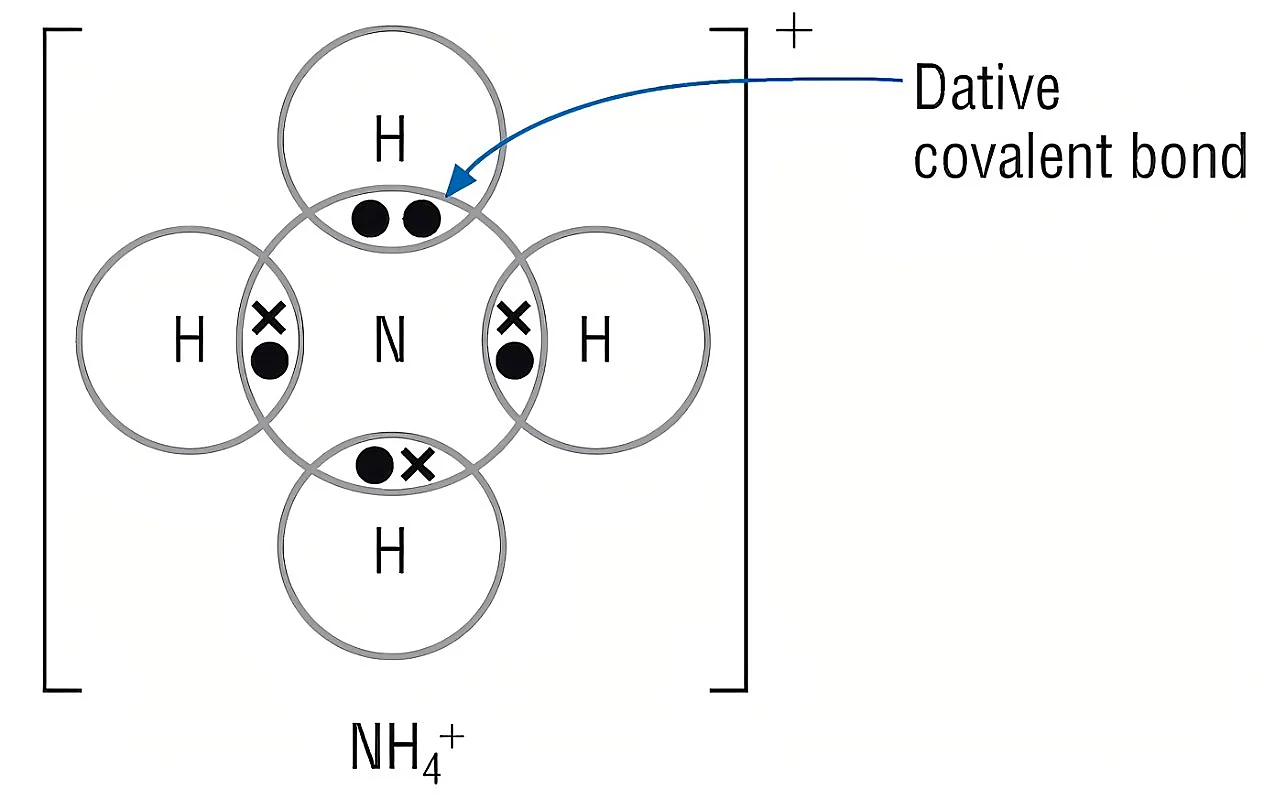
NH3 + H+ → NH4+ (lone pair on N accepts proton; coordinate bond formed). NH3 + H2O ⇌ NH4+ + OH (weak base).

Dot-and-cross diagram of ammonium showing nitrogen donating both electrons in the coordinate bond
In NH4+, nitrogen donates its lone pair to H+. After formation, all four N-H bonds are equivalent even though one began as a coordinate bond.

12.3 NOx in the Atmosphere

  • Formed by lightning and in internal-combustion engines: N2 + O2 → 2NO at high temperature; 2NO + O2 → 2NO2.
  • NO catalyses oxidation of SO2: NO + ½O2 → NO2; NO2 + SO2 → NO + SO3 — contributes to acid rain.
  • Catalytic converter (Pt/Rh): 2NO + 2CO → N2 + 2CO2.

12.4 Acid Rain

SO2 + H2O → H2SO3; SO3 + H2O → H2SO4. Effects: damages plants, corrodes limestone and metal; treated by flue-gas desulfurisation with CaO/CaCO3.

12.5 Haber and Contact Processes

Haber: N2 + 3H2 ⇌ 2NH3, Fe catalyst, ~450 °C, ~200 atm. Contact: 2SO2 + O2 ⇌ 2SO3, V2O5, ~450 °C, ~1–2 atm; SO3 is dissolved in conc. H2SO4 then diluted (never add SO3 straight to water).

13Introduction to AS Organic Chemistry

Functional groups, IUPAC nomenclature, structural and stereoisomerism, hybridisation and curly-arrow mechanisms.

13.1 Functional Groups (AS)

Alkene C=C, halogenoalkane C-X, alcohol -OH, aldehyde -CHO, ketone C=O, carboxylic acid -COOH, ester -COO-, amine -NH2, nitrile -CN.

13.2 Nomenclature

IUPAC system. Longest chain — root (meth, eth, prop, but, pent, hex); add prefixes/suffixes; numbers indicate position; lowest locants overall.

13.3 Isomerism

  • Structural: chain, positional, functional-group.
  • Geometrical (cis/trans, E/Z): restricted rotation around C=C; two different groups on each sp2 C.
  • Optical: chiral C with four different groups — non-superimposable mirror images (enantiomers); rotate plane-polarised light in opposite directions.

13.4 Hybridisation

HybridGeometryAngleExample
sp3Tetrahedral109.5°CH4
sp2Trigonal planar120°C=C, C=O
spLinear180°C≡C, C≡N

13.5 Reaction Types

Addition, substitution (free-radical, SN1, SN2), elimination, hydrolysis, condensation, oxidation, reduction.

13.6 Curly Arrows

Full arrow = movement of a pair of electrons (heterolytic). Half (fish-hook) arrow = movement of one electron (homolytic / radical). Arrow tail starts at a bond or lone pair; head points to where electrons go.

13.7 Stereoisomerism at AS

Cis–trans / E–Z needs a C=C (no rotation) and two different groups on each carbon. Optical isomerism needs a chiral carbon (four different groups); a pair of non-superimposable mirror images rotates plane-polarised light equally in opposite directions.

14Hydrocarbons

Alkanes (free-radical substitution, cracking) and alkenes (electrophilic addition, Markovnikov, addition polymerisation).

14.1 Alkanes

  • Unreactive: non-polar, strong C-C and C-H bonds.
  • Combustion: complete → CO2 + H2O; incomplete → CO + soot.
  • Cracking: thermal (heat + Al2O3) → shorter alkanes + alkenes.

14.2 Free-Radical Substitution with X2/UV

Three stages — write all equations using half-arrows:

  • Initiation: Cl2 → 2Cl• (UV)
  • Propagation: CH4 + Cl• → CH3• + HCl; CH3• + Cl2 → CH3Cl + Cl•
  • Termination: Cl• + Cl• → Cl2; CH3• + Cl• → CH3Cl; 2CH3• → C2H6
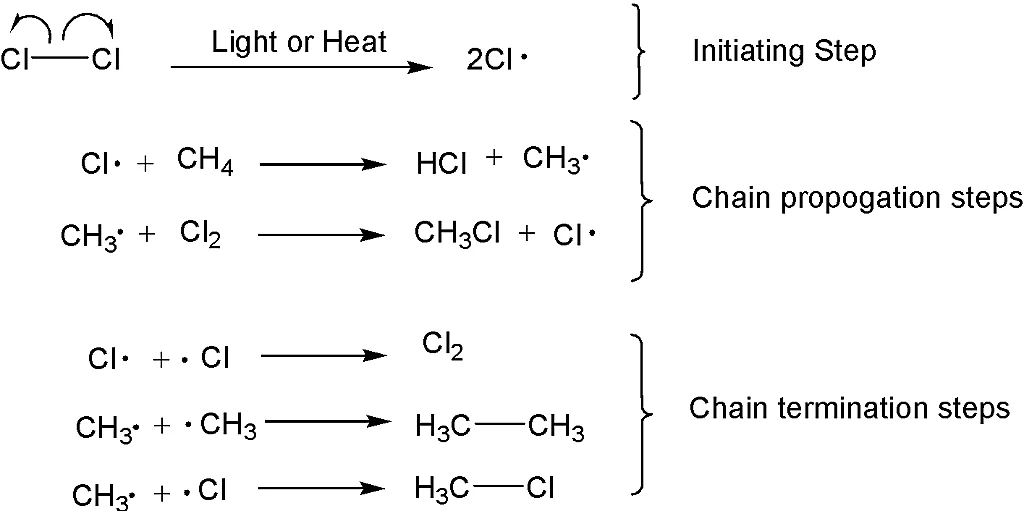
Initiation, propagation and termination steps in chlorination of methane
The propagation steps consume one radical and create another, so the chain continues. Termination removes radicals when two collide.

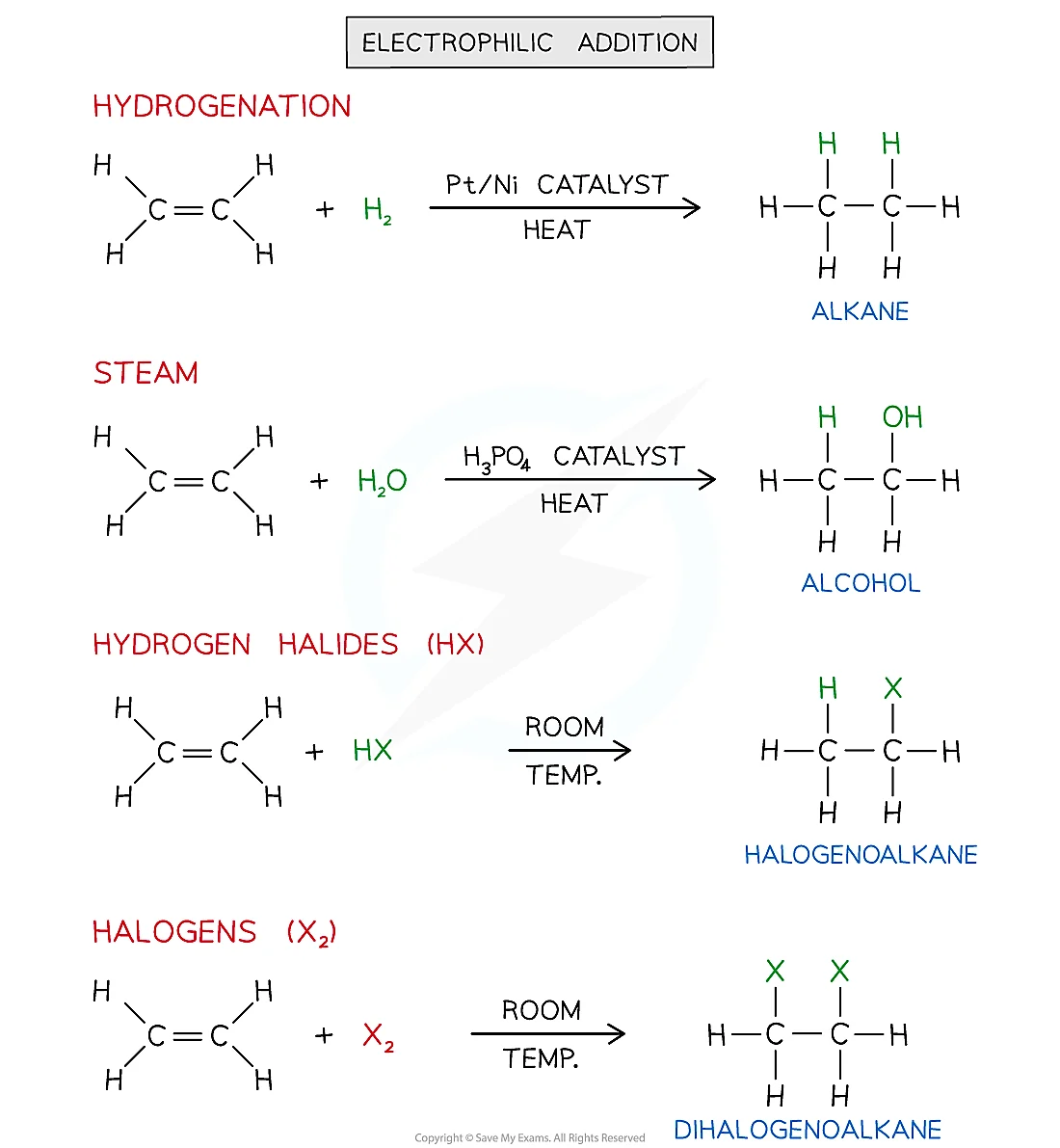
14.3 Alkenes — Electrophilic Addition

Reagent / conditionsProduct
H2 / Pt or Ni, heatAlkane (hydrogenation)
Steam / H3PO4, 300 °C, 60 atmAlcohol
HX(g)Halogenoalkane (Markovnikov)
Br2(aq)Bromohydrin (decolourises — test for C=C)
Cold dilute KMnO4 / H+Diol (purple → colourless)
Hot conc. KMnO4Cleaves C=C → carbonyls / CO2
Summary of hydrogenation, hydration, hydrogen-halide addition and halogen addition across a carbon-carbon double bond
The C=C π bond opens during addition. The atoms from the reagent attach across the two carbon atoms, producing a saturated product.
Markovnikov's rule: H adds to the C with more H atoms — the major product proceeds via the more stable secondary/tertiary carbocation (positive inductive effect of alkyl groups).

14.4 Addition Polymerisation

n CH2=CHX → [−CH2−CHX−]n. Examples: poly(ethene), PVC, polystyrene. Non-biodegradable; toxic on incineration (PVC → HCl).

14.5 Making Alkenes

  • Elimination of HX from a halogenoalkane: ethanolic NaOH, heat.
  • Dehydration of an alcohol: heated Al2O3 or conc. H2SO4.
  • Cracking of a longer alkane over Al2O3.

14.6 Electrophilic Addition — Reagents and Markovnikov

  • H2 / Ni or Pt, heat → alkane.
  • Steam / H3PO4 → alcohol.
  • HX(g), r.t. → halogenoalkane. The H adds to the carbon already having more H (more stable 2°/3° carbocation; alkyl groups are electron-releasing).
  • X2 → dihalogenoalkane. Br2(aq) decolorised is the C=C test.
  • Cold dilute acidified KMnO4 → diol (purple to colourless).
  • Hot concentrated acidified KMnO4 cleaves the C=C; the fragments tell you where the double bond was.

14.7 Alkanes — Combustion and Cracking

Alkanes are unreactive to polar reagents (strong, non-polar C–H). Incomplete combustion gives CO and C. Catalytic converters remove CO, NOx and unburnt hydrocarbons. Cracking heavier fractions gives more useful shorter alkanes and alkenes.

15Halogen Compounds

Reactions of halogenoalkanes (SN1, SN2, elimination) and relative reactivity by C-X bond strength.

15.1 Key Reactions

Reagent / conditionsProductType
NaOH(aq) / heatAlcoholNucleophilic substitution
KCN in ethanol / heatNitrile (chain +1 C)Nucleophilic substitution
NH3 in ethanol / heat + pressurePrimary amineNucleophilic substitution
NaOH in ethanol / heatAlkeneElimination
AgNO3 in ethanol / warmIdentification by AgX colour

15.2 SN1 vs SN2

  • SN1: two steps; rate = k[RX]; carbocation intermediate; tertiary preferred (more stable cation).
  • SN2: one step; rate = k[RX][Nu]; backside attack; primary preferred (less steric hindrance).
  • Secondary: mixture.

15.3 C-X Reactivity

C-I (weakest, longest) > C-Br > C-Cl > C-F. AgNO3/ethanol test: yellow AgI ppt forms fastest; AgCl white ppt slowest; AgF none.

Common error: citing electronegativity to predict reactivity. The dominant factor is bond strength: weaker C-X means easier C-X breakage.

15.4 Nucleophilic Substitution — Reagents

  • NaOH(aq), heat → alcohol.
  • KCN in ethanol, heat → nitrile (one extra carbon).
  • NH3 in ethanol, heat under pressure → amine.
  • AgNO3(aq) in ethanol: rate of AgX ppt identifies the halogen (C–I fastest, weakest bond).

Ethanolic NaOH, heat → elimination to an alkene. Primary halogenoalkanes favour SN2; tertiary favour SN1.

16Hydroxy Compounds (Alcohols)

Classification, oxidation to carbonyls/acids, dehydration to alkenes, esterification, and the iodoform test.

16.1 Classification

  • Primary (1°): -CH2OH (e.g. ethanol).
  • Secondary (2°): -CHOH- (e.g. propan-2-ol).
  • Tertiary (3°): -C(R)(R')OH (e.g. 2-methylpropan-2-ol).

16.2 Oxidation

Reagent: K2Cr2O7(aq) / dil. H2SO4 (orange → green) or KMnO4 / H+.

AlcoholDistil immediatelyReflux
PrimaryAldehydeCarboxylic acid
SecondaryKetoneKetone (no further oxidation)
TertiaryNo reaction — stays orangeNo reaction
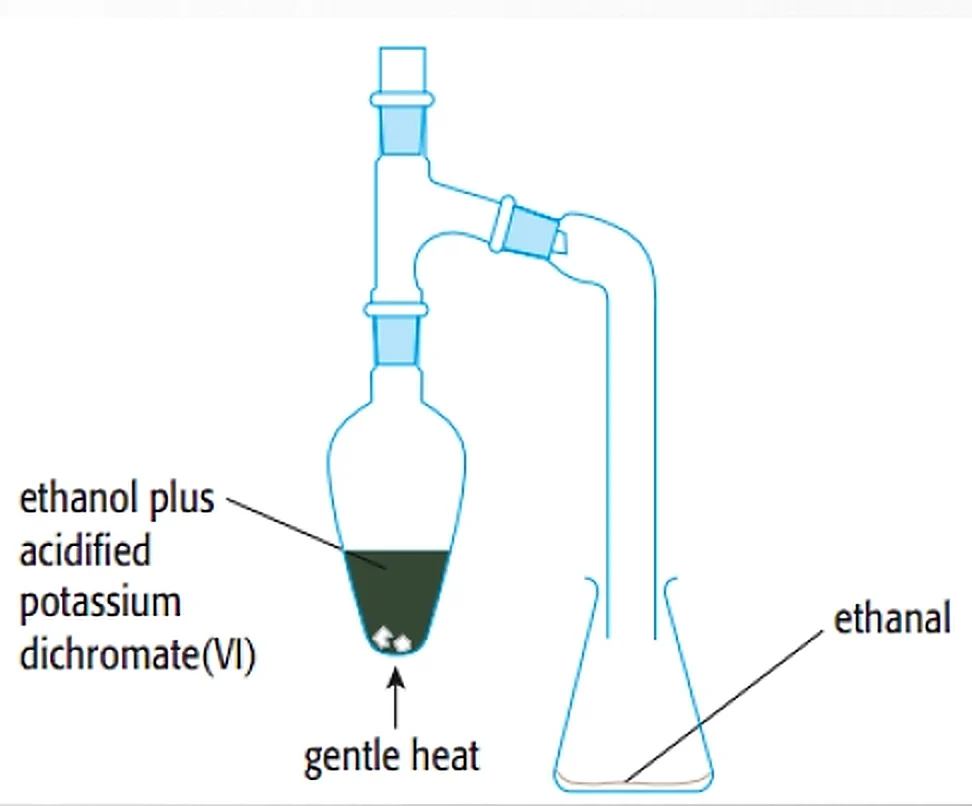
Ethanol and acidified potassium dichromate heated gently while ethanal is distilled off
Distil the aldehyde as it forms to prevent further oxidation. Reflux instead keeps it with the oxidising agent, producing the carboxylic acid.

16.3 Other Reactions

  • Na(s) → sodium alkoxide + ½H2 (slow, less vigorous than water with Na).
  • Conversion to halogenoalkane: HX(g); KCl + conc. H2SO4; PCl3 + heat; PCl5; SOCl2.
  • Dehydration: conc. H2SO4 at 170 °C, or Al2O3(s) hot → alkene.
  • Esterification: + RCOOH / conc. H2SO4 cat. → ester + H2O (reversible).

16.4 Iodoform Test

I2 / NaOH(aq), warm. Yellow precipitate CHI3 (triiodomethane) — presence of CH3CH(OH)- or CH3CO- group.

16.5 Making Alcohols and Further Reactions

Routes: steam + alkene / H3PO4; NaOH(aq) + halogenoalkane; NaBH4 or LiAlH4 on a carbonyl; LiAlH4 on a carboxylic acid; hydrolysis of an ester.

  • Na(s) → sodium alkoxide + H2. Alcohols are weaker acids than water.
  • PCl5, SOCl2 or HX → halogenoalkane (steamy fumes with PCl5 test the OH).
  • Conc. H2SO4 or Al2O3, heat → alkene (dehydration).
  • Carboxylic acid + conc. H2SO4 → ester.
  • Acidified K2Cr2O7: distill a 1° alcohol to the aldehyde; reflux to the acid. 2° → ketone. 3° no reaction (stays orange).

17Carbonyl Compounds

Aldehydes and ketones: nucleophilic addition with HCN, reduction, and distinguishing tests.

17.1 Common Reactions

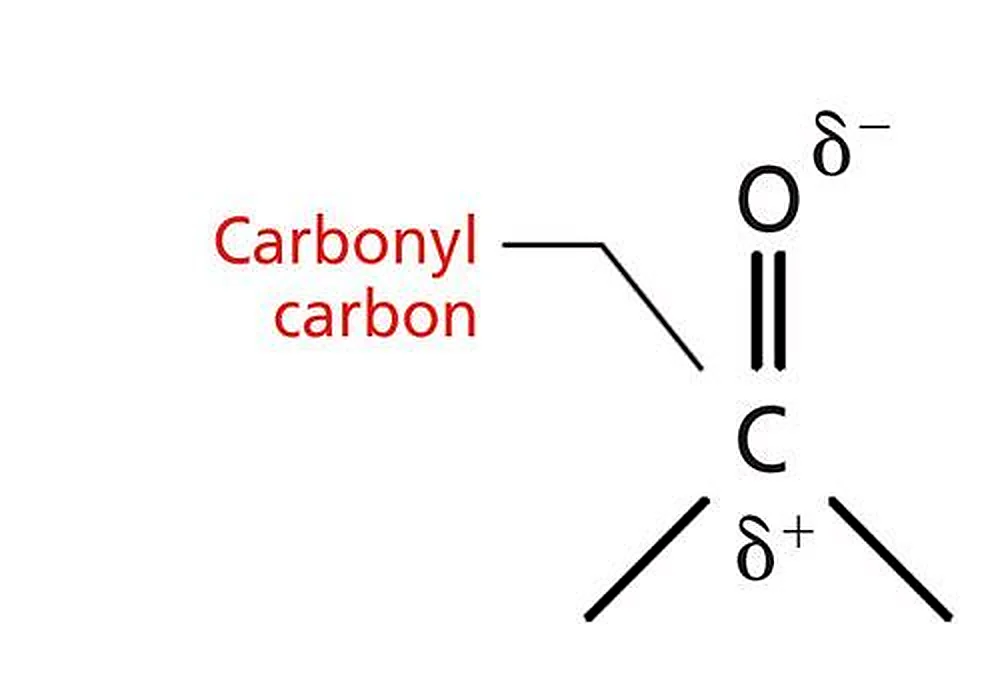
Polar carbonyl group with a partially positive carbon and partially negative oxygen
Oxygen withdraws electron density from C=O, leaving carbon δ+. Nucleophiles therefore attack the carbonyl carbon.
ReagentAldehydeKetone
NaBH4 or LiAlH4 / dry ether1° alcohol2° alcohol
HCN / KCN(cat.)2-hydroxynitrile2-hydroxynitrile
2,4-DNPHOrange pptOrange ppt
Tollens' reagent [Ag(NH3)2]+Silver mirrorNo reaction
Fehling's solutionBrick-red Cu2O pptNo reaction
I2 / NaOHYellow CHI3 ppt (only if CH3CHO)Yellow CHI3 ppt (only if methyl ketone)

17.2 Mechanism of HCN Addition (Nucleophilic Addition)

  1. CN attacks δ+ carbon of C=O (curly arrow from CN lone pair to C).
  2. π electrons of C=O move onto O → alkoxide intermediate.
  3. H+ (from HCN or H2O) protonates O → 2-hydroxynitrile.
If carbonyl is asymmetric (e.g. CH3CHO), product has a chiral C — racemic mixture (50:50) because CN attacks both faces with equal probability.

17.3 Distinguishing Tests

  • 2,4-DNPH: orange/yellow ppt with any carbonyl (aldehyde or ketone).
  • Tollens' (ammoniacal AgNO3, warm): silver mirror with aldehydes only.
  • Fehling's / Benedict's: brick-red Cu2O with aliphatic aldehydes.
  • Alkaline I2: yellow CHI3 ppt if a CH3CO− or CH3CH(OH)− group is present.

Reduction with NaBH4 or LiAlH4 gives the corresponding alcohol. HCN / KCN, heat gives a hydroxynitrile (nucleophilic addition — extra carbon).

18Carboxylic Acids and Esters

Naming, hydrogen bonding, acid reactions, esterification and hydrolysis.

18.1 Structure and Physical Properties

The carboxyl group is −COOH. Methanoic, ethanoic, propanoic acids are the first three. Two molecules dimerise through two hydrogen bonds, so boiling points are higher than alcohols of similar Mr. Short-chain acids mix with water; longer chains do not.

18.2 Reactions of Carboxylic Acids

  • Na or Mg → salt + H2.
  • NaOH or Na2CO3/NaHCO3 → salt + H2O (+ CO2 with carbonate). Effervescence with carbonate distinguishes them from phenol and alcohols.
  • Alcohol + conc. H2SO4 / heat → ester + H2O (reversible).
  • LiAlH4 in dry ether, then acid → primary alcohol. NaBH4 does not reduce carboxylic acids.
  • PCl5 or SOCl2 → acyl chloride (steamy HCl fumes with PCl5).

18.3 Why They Are Acidic

Stronger than alcohols and phenol because the carboxylate ion is resonance-stabilised: the negative charge is shared equally over both oxygen atoms. Still weak acids: only partially dissociated in water.

18.4 Esters

Named as alkyl alkanoates (CH3COOCH2CH3 is ethyl ethanoate). Pleasant smells; used as solvents and flavourings.

HydrolysisConditionsProductsReversible?
Aciddilute H2SO4, heatacid + alcoholYes — excess water needed
Alkali (saponification)dilute NaOH, heatcarboxylate salt + alcoholNo — salt does not re-esterify

18.5 Making Carboxylic Acids

  • Reflux a 1° alcohol or an aldehyde with acidified K2Cr2O7 / KMnO4.
  • Hydrolyse a nitrile (dilute acid, or alkali then acidify).
  • Hydrolyse an ester, then acidify if alkali was used.

19Nitrogen Compounds (AS)

Primary amines, nitriles and hydroxynitriles: production, basicity, hydrolysis and reduction.

19.1 Primary Amines

Amines are derivatives of ammonia in which one or more H atoms are replaced by alkyl or aryl groups. A primary amine has one alkyl/aryl group attached to the nitrogen atom: R-NH2.

Basicity: amines act as bases because the lone pair on N can accept a proton (H+) from water or acid.

Order of base strength: ethylamine > ammonia > phenylamine

  • Ethylamine: the ethyl group is electron-donating (+I effect), pushing electron density towards N — lone pair more available — stronger base.
  • Ammonia: three H atoms on N; no electron-donating alkyl group.
  • Phenylamine: the lone pair on N is delocalised into the benzene ring — less available to accept H+ — weakest base.

19.2 Production of Primary Amines

MethodReagents / conditionsEquation
From halogenoalkaneExcess NH3 in ethanol, heat under pressureR-X + NH3 → R-NH2 + HX
From nitrileLiAlH4 in dry ether; or H2 / Ni catalystR-CN + 4[H] → R-CH2NH2
From amideLiAlH4 in dry etherR-CONH2 + 4[H] → R-CH2NH2 + H2O
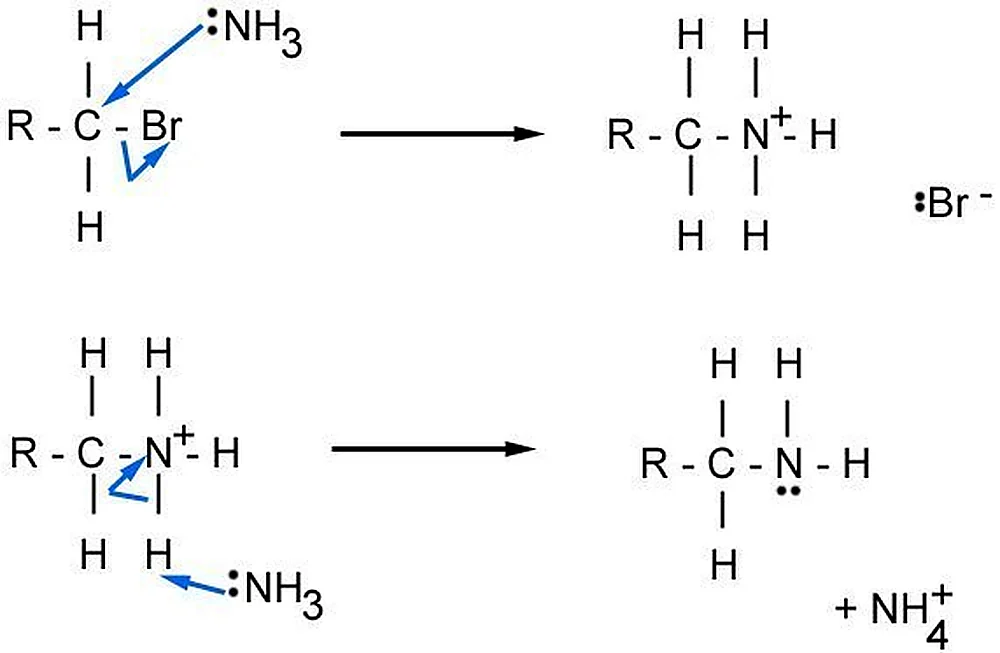
Two-step formation of a primary amine from a halogenoalkane and ammonia
Ammonia first attacks the halogenoalkane to form an alkylammonium ion; a second ammonia molecule removes H+, giving the primary amine.
Excess ammonia is essential when making amines from halogenoalkanes to prevent further substitution: secondary amine (R2NH), tertiary amine (R3N) and quaternary ammonium salt (R4N+X) can all form.

19.3 Nitriles

Nitriles contain the -C≡N functional group. They are useful for chain extension (adding one carbon atom to the chain).

  • Formation: R-X + KCN in ethanol, reflux → R-CN + KX (nucleophilic substitution; chain lengthens by 1 C).
  • Hydrolysis: reflux with dilute HCl or H2SO4 → carboxylic acid + NH4+ salt.
    CH3CH2CN + 2H2O + HCl → CH3CH2COOH + NH4Cl
  • Reduction: LiAlH4 / dry ether or H2 / Ni → primary amine.
    CH3CN + 4[H] → CH3CH2NH2

19.4 Hydroxynitriles

Carbonyl compounds (aldehydes and ketones) react with HCN (in the presence of a base catalyst such as KCN or NaCN) to form 2-hydroxynitriles (cyanohydrins).

CH3CHO + HCN → CH3CH(OH)CNethanal → 2-hydroxypropanenitrile

Hydroxynitriles are useful intermediates:

  • Hydrolysis of the -CN group → α-hydroxy carboxylic acid (e.g. CH3CH(OH)CN + 2H2O + H+ → CH3CH(OH)COOH + NH4+).
  • Reduction of the -CN group → amino alcohol (e.g. CH3CH(OH)CN + 4[H] → CH3CH(OH)CH2NH2).
If the carbonyl carbon is part of an asymmetric molecule, the product contains a chiral centre — racemic mixture formed because CN attacks both faces of the planar C=O with equal probability.

20Polymerisation (AS)

Addition polymers from alkenes, repeat unit identification, and environmental impact.

20.1 Addition Polymerisation

Addition polymerisation involves the joining together of many alkene monomer units. The C=C double bond opens up and the monomers link together to form long chains. No small molecules are lost.

n CH2=CH2 → [−CH2−CH2−]npoly(ethene)

Repeat unit: the smallest repeating section of the polymer chain. To draw a repeat unit from a monomer: open the C=C and put brackets around the two-carbon fragment.
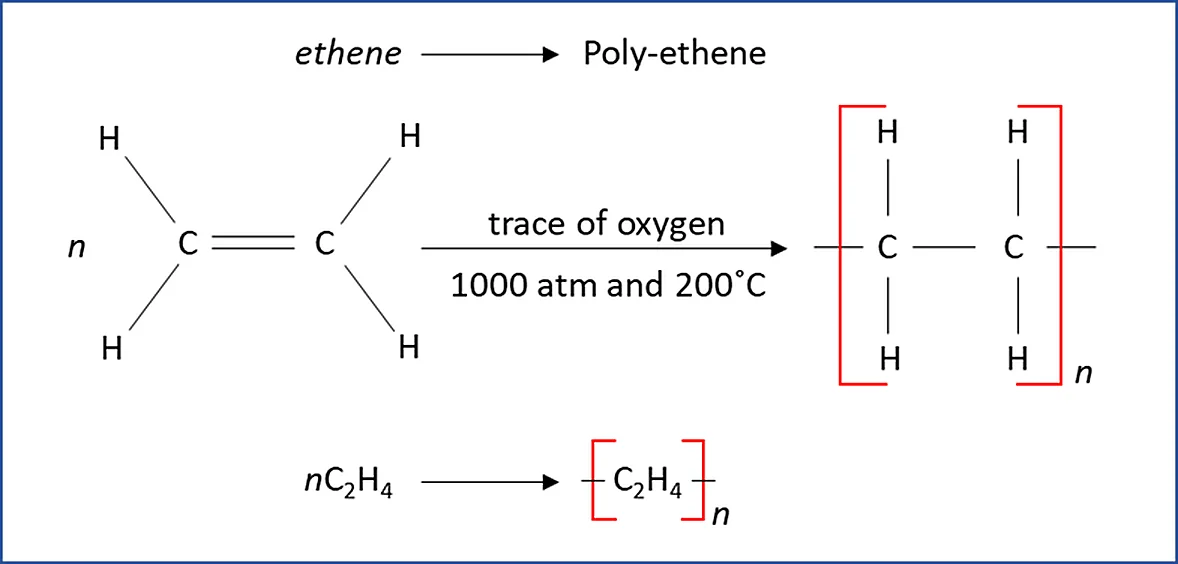
Ethene monomers becoming the bracketed repeat unit of polyethene
Open the monomer C=C to form two single bonds that continue through the brackets; retain the substituents on their original carbon atoms.
MonomerRepeat unitPolymer nameCommon use
ethene[−CH2−CH2−]poly(ethene)plastic bags, bottles
chloroethene[−CH2−CHCl−]poly(chloroethene) (PVC)pipes, window frames
propene[−CH2−CH(CH3)−]poly(propene)crates, rope
phenylethene[−CH2−CH(C6H5)−]poly(phenylethene) (polystyrene)packing, insulation
tetrafluoroethene[−CF2−CF2−]poly(tetrafluoroethene) (PTFE)non-stick coatings

20.2 Deducing the Monomer from a Repeat Unit

Work backwards: replace the single C-C bond in the repeat unit with a C=C double bond, and remove the brackets. Any side groups stay attached to the same carbon.

Example: repeat unit [−CH2−CHCl−] → monomer is CH2=CHCl (chloroethene).

20.3 Environmental Issues

  • Non-biodegradable: C-C backbone is chemically inert; bacteria and fungi cannot break it down. Polymers persist in landfill for hundreds of years.
  • Toxic combustion products: PVC releases HCl; polyurethanes release HCN; burning polystyrene releases soot and CO.
  • Solutions: recycling (mechanical: melting and remoulding; chemical: cracking back to monomers), biodegradable alternatives (e.g. polylactic acid from corn starch), and energy recovery (incineration for electricity generation).

21Organic Synthesis (AS)

Designing multi-step routes between functional groups using AS reagents.

21.1 Strategy

  1. Identify start and target functional groups.
  2. Plan a route via known intermediates (alcohol ↔ halogenoalkane ↔ alkene ↔ carbonyl ↔ acid ↔ ester).
  3. Specify reagents, solvent, temperature and catalyst for each step.
  4. Avoid steps that produce unwanted by-products; consider chain length.

21.2 Key Conversions

FromToReagents / conditions
AlkeneHalogenoalkaneHBr(g) or HCl(g)
AlkeneAlcoholSteam / H3PO4, 300 °C, 60 atm
AlkeneDiolCold dilute KMnO4 / H+
HalogenoalkaneAlcoholNaOH(aq), reflux
HalogenoalkaneAlkeneNaOH in ethanol, heat
HalogenoalkaneNitrile (chain +1C)KCN in ethanol, reflux
HalogenoalkanePrimary amineNH3 in ethanol, heat, pressure
AlcoholAldehydeK2Cr2O7/H+, distil
AlcoholCarboxylic acidK2Cr2O7/H+, reflux
AlcoholHalogenoalkanePCl5 or SOCl2 or KBr + conc. H2SO4
AlcoholAlkeneconc. H2SO4, 170 °C or Al2O3, hot
AlcoholEsterRCOOH + conc. H2SO4 cat., warm
AldehydePrimary alcoholNaBH4 or LiAlH4 / dry ether
AldehydeCarboxylic acidK2Cr2O7/H+, reflux
KetoneSecondary alcoholNaBH4 or LiAlH4 / dry ether
Carboxylic acidPrimary alcoholLiAlH4 / dry ether
Carboxylic acidEsterROH + conc. H2SO4 cat., warm
Carboxylic acidCarboxylate saltNaOH, Na2CO3, or reactive metal
NitrileCarboxylic acidDilute HCl or H2SO4, reflux
NitrilePrimary amineLiAlH4 / dry ether or H2 / Ni
When planning a synthesis, always check the carbon count. Converting a halogenoalkane to a nitrile adds one carbon to the chain (R-X → R-CN → R-CH2NH2 or R-COOH).

21.3 Multi-step Routes

Identify every functional group, then list the type of reaction and the exact reagent/condition for each step. Watch for extra carbons (KCN) and for oxidation that can overshoot (distil vs reflux). Possible by-products: further substitution of amines, over-oxidation of aldehydes, elimination competing with substitution.

22Analytical Techniques (AS — IR & MS)

Identifying functional groups by IR absorption and deducing molecular structure from mass spectra.

22.1 Infrared Spectroscopy

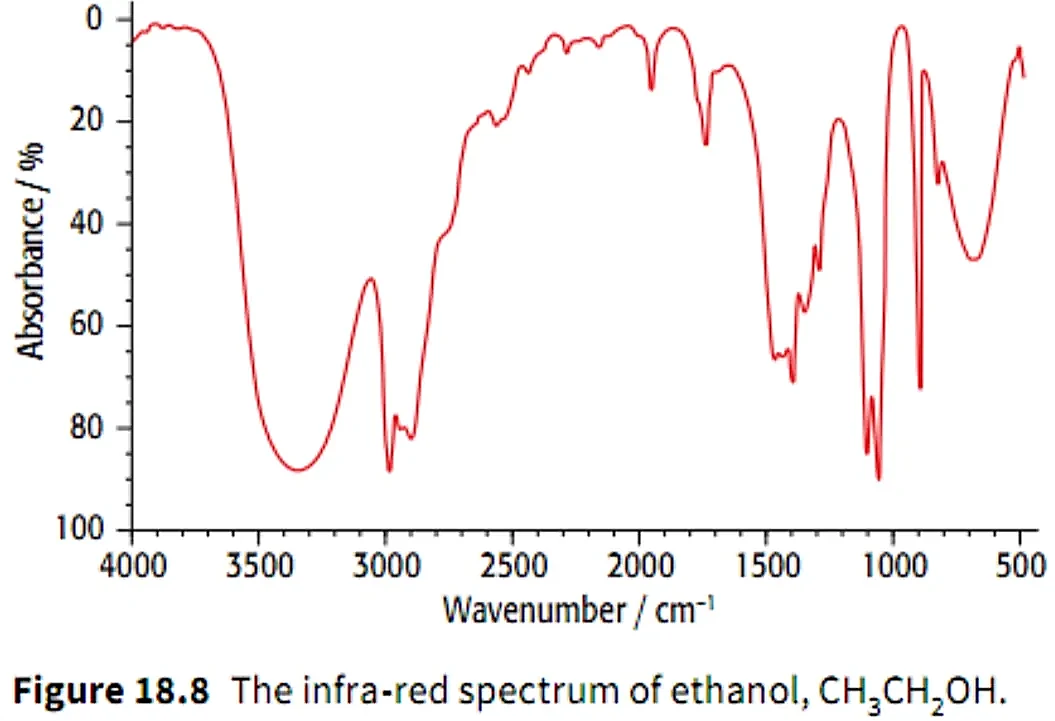
Infrared spectrum of ethanol with a broad alcohol O-H absorption
IR spectrum of ethanol: identify the broad alcohol O-H absorption around 3200-3600 cm−1 before using the fingerprint region.
BondGroupWavenumber / cm−1
C-Oalcohol, ester1040-1300
C=Calkene, arene1500-1680
C=Oaldehyde, ketone, acid1670-1740
C=Oester1710-1750
C≡Nnitrile2200-2250
C-Halkane2850-2950
O-H (broad)carboxylic acid2500-3000
N-Hamine, amide3300-3500
O-Halcohol3200-3600

22.2 Mass Spectrometry

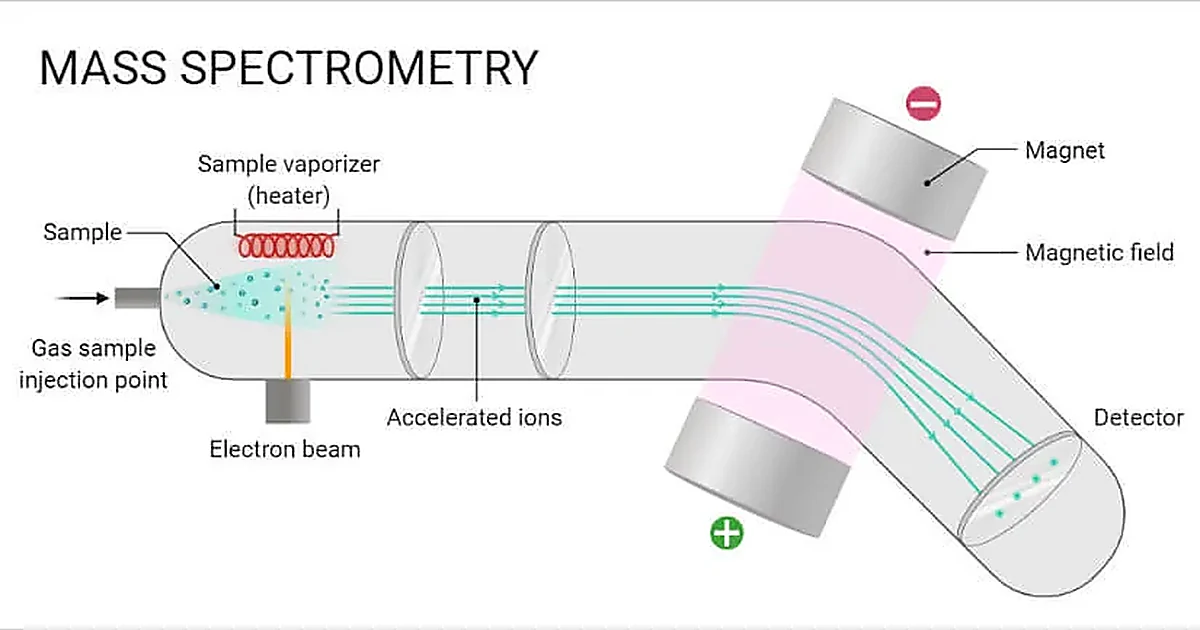
Mass spectrometer showing vaporisation, ionisation, acceleration, deflection and detection
Mass-spectrometer sequence: vaporise, ionise, accelerate, deflect in a magnetic field, then detect ions according to m/z.
  • M+ peak — molecular mass.
  • [M+1]+ from 13C: nC = 100 × I(M+1) / (1.1 × I(M)).
  • [M+2]+: M:M+2 ≈ 3:1 for one Cl (35Cl:37Cl), and ≈ 1:1 for one Br (79Br:81Br).
  • Fragmentation: loss of 15 (CH3), 17 (OH), 29 (CHO or C2H5), 31 (OCH3), 43 (C3H7 or CH3CO), 45 (COOH or OC2H5).
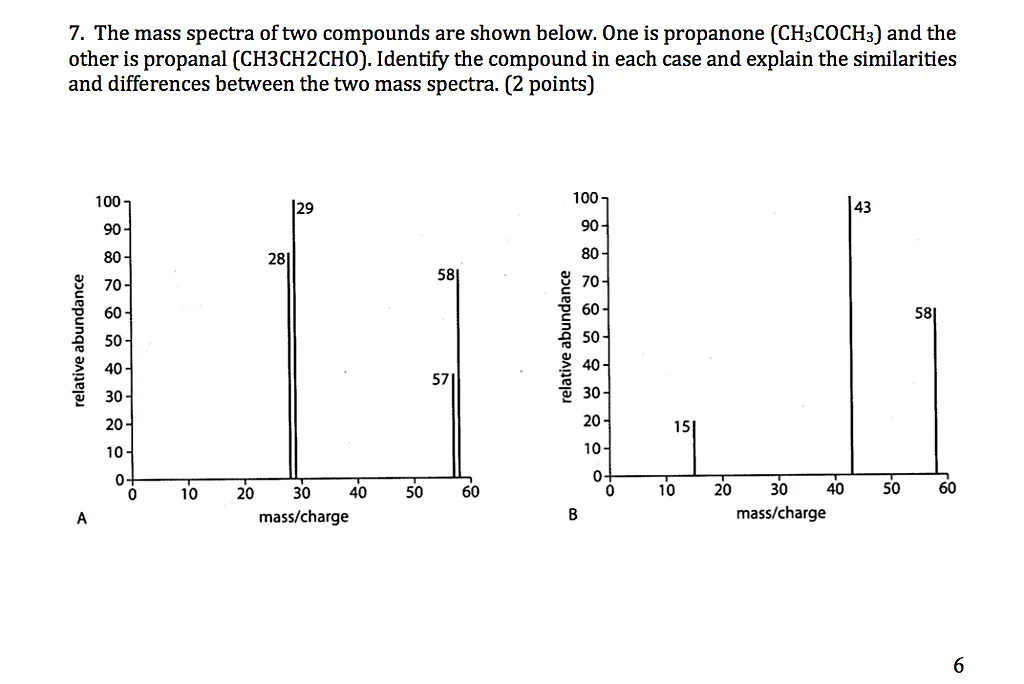
Mass spectra of propanone and propanal showing different fragment peak patterns
Compounds with the same molecular formula can share the same molecular-ion mass but give different fragment patterns; those patterns act as structural fingerprints.
Isotope of Cl: M:M+2 — 3:1; isotope of Br: M:M+2 — 1:1.

22.3 Using the Data-Booklet Peaks

IR: match strong absorptions to O−H (broad, acids very broad), C=O (~1700 cm−1), C−O, C≡N, C−H. Absence of a peak can be as useful as its presence.

MS: M+ peak gives Mr. The [M+1]+ peak height estimates the number of carbons. Simple fragments (15 = CH3, 29 = C2H5 / CHO, 77 = C6H5) identify pieces. Ar from isotope abundances is a weighted mean.

ASRevision Guide Exam Boosters

Condensed additions from the AS part of the local CIE 9701 complete revision guide: practical wording, calculation discipline, reaction conditions and common examiner traps.

AS Paper 1/2 high-yield checks

AreaWhat to write in exam answersCommon trap
Atomic structureUse proton number to define the element; use mass number minus proton number for neutrons. For ionisation energy definitions, include gaseous atoms, one mole and one electron.For transition-metal ions, remove 4s electrons before 3d electrons.
StoichiometryConvert volumes to dm3 for concentration calculations and temperatures to K for pV = nRT. Use the balanced equation mole ratio before deciding the limiting reagent.Using the reagent in excess as the limiting reagent because it has the larger starting mass.
Bonding and structureLink property to structure and bonding: type of particles, forces between them, and whether mobile charged particles are present.Saying "strong intermolecular forces" for giant ionic, metallic or covalent structures.
EnergeticsFor Hess cycles, keep arrows consistent. For calorimetry, quote heat loss, incomplete combustion and evaporation as likely reasons experimental values are less exothermic.Forgetting that bond breaking is endothermic and bond making is exothermic.
Equilibrium and ratesOnly temperature changes Kc or Kp. Catalysts increase both forward and reverse rates equally. Temperature increases rate mainly by greatly increasing the fraction with E ≥ Ea.Claiming a catalyst changes equilibrium yield or that rate orders come from equation coefficients.

AS organic reaction conditions

ConversionReagents and conditionsObservation / exam note
Alkane to halogenoalkaneCl2 or Br2, ultraviolet lightFree-radical substitution; mixture of products likely.
Alkene to alcoholSteam, H3PO4 catalyst, high temperature and pressureHydration; addition across C=C.
Alkene testBr2(aq), room temperatureOrange/brown to colourless; electrophilic addition.
Halogenoalkane to alcoholNaOH(aq), heat under refluxNucleophilic substitution.
Halogenoalkane to alkeneNaOH or KOH in ethanol, heatElimination; forms H2O and halide ion.
Primary alcohol to aldehydeAcidified K2Cr2O7, distilDistillation prevents further oxidation.
Primary alcohol to carboxylic acidAcidified K2Cr2O7, refluxUse excess oxidising agent; orange to green.
Carbonyl to hydroxynitrileHCN generated from KCN/NaCN and dilute acidPlanar C=O gives a racemic mixture if a chiral centre forms.
Nitrile to amineLiAlH4 in dry ether, then waterAdds one carbon before reduction when made from halogenoalkane + CN-.

AS practical wording

  • Titration reliability: rinse burette with the solution it will contain, remove funnel before titrating, read the meniscus at eye level, and repeat until concordant titres are obtained.
  • Calorimetry improvements: use a lid, insulation, a draught shield and a more precise thermometer; extrapolate cooling curves when required.
  • Qualitative analysis: describe precipitate colour, solubility in excess reagent, gas test and final inference. Do not infer an ion from colour alone.
  • Uncertainty: percentage uncertainty = absolute uncertainty / measured value x 100. For repeated measurements, use half the range as an estimate when appropriate.
These notes are AI-assisted study material. Always cross-check against the official 9701 syllabus or your teacher before relying on them in an exam.

9701 A2 Level Chemistry

A2 Notes — Cambridge International (2025-2027)
Paper 4 — A2 Structured Paper 5 — Planning & Analysis 15 Topics

23Chemical Energetics (A2)

Lattice energy and the Born-Haber cycle, hydration enthalpies, entropy and Gibbs free energy.

23.1 Lattice Energy

ΔHlatt°: the enthalpy change when 1 mole of an ionic solid is formed from its gaseous ions under standard conditions. Always exothermic.

Magnitude (more negative) — with higher charge and smaller radius (higher charge density) — e.g. MgO >> NaCl.

23.2 Born-Haber Cycle

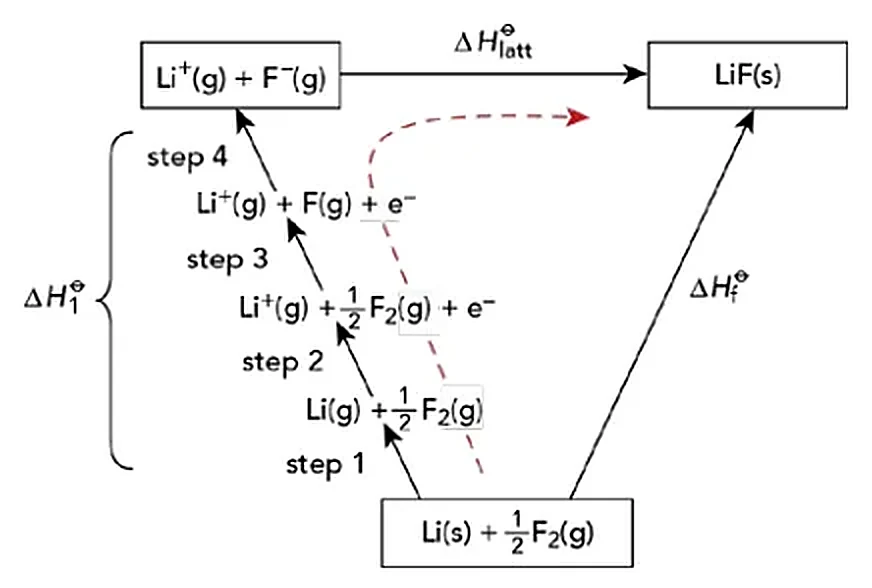
Born-Haber cycle for the formation of lithium fluoride
Born-Haber cycle for LiF. Check the physical state of every species and the sign of each enthalpy change before solving for lattice enthalpy.

Apply Hess's law:

ΔHf°(MX) = ΔHat(M) + IE(M) + ΔHat(X) + EA(X) + ΔHlatt°(MX)
  • ΔHat: enthalpy of atomisation (form 1 mol gaseous atoms).
  • IE: ionisation energy (always +).
  • EA: electron affinity (1st usually −; 2nd always +).
Worked example: Born-Haber for NaCl
Given: ΔHf(NaCl) = −411 kJ mol−1; ΔHat(Na) = +107; IE(Na) = +496; ΔHat(Cl) = +122; EA(Cl) = −349. Calculate ΔHlatt.

ΔHf = ΔHat(Na) + IE(Na) + ΔHat(Cl) + EA(Cl) + ΔHlatt
−411 = 107 + 496 + 122 + (−349) + ΔHlatt
ΔHlatt = −411 − 376 = −787 kJ mol−1

23.3 Enthalpy of Solution

ΔHsol = −ΔHlatt + ΣΔHhyd

ΔHhyd: enthalpy when 1 mol of gaseous ions becomes hydrated. Always exothermic; more negative for smaller / higher-charge ions.

23.4 Entropy

Entropy S: a measure of the number of ways energy and particles can be arranged in a system.

ΔS positive for melting, boiling, dissolving, ↑ moles of gas, increased disorder. Calculate: ΔS = ΣS°(products) − ΣS°(reactants).

23.5 Gibbs Free Energy

ΔG° = ΔH° − TΔS°

Feasible (spontaneous) if ΔG < 0. Equilibrium temperature: T = ΔH°/ΔS° (where ΔG = 0). Units: ΔH in kJ; convert ΔS to kJ K−1.

24Electrochemistry (A2)

Electrolysis quantitative work, standard electrode potentials, cell EMF, and the Nernst equation.

24.1 Electrolysis Calculations

Q = It  |  n(e) = Q / F  |  F = 96 500 C mol−1
mass = (M × It) / (n × F)
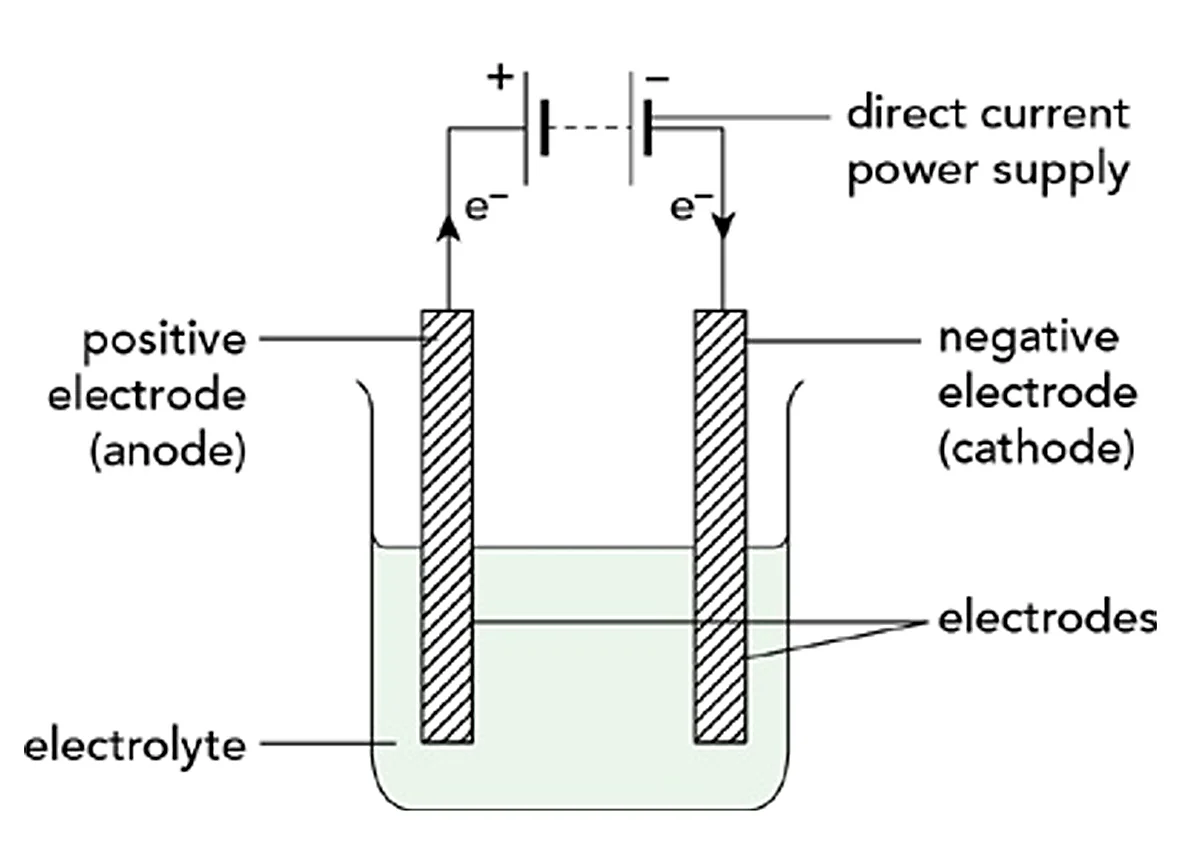
Electrolytic cell connected to a direct-current supply with positive anode and negative cathode
In an electrolytic cell, the external supply makes the anode positive and the cathode negative. Oxidation occurs at the anode and reduction at the cathode.

24.2 Standard Electrode Potential E°

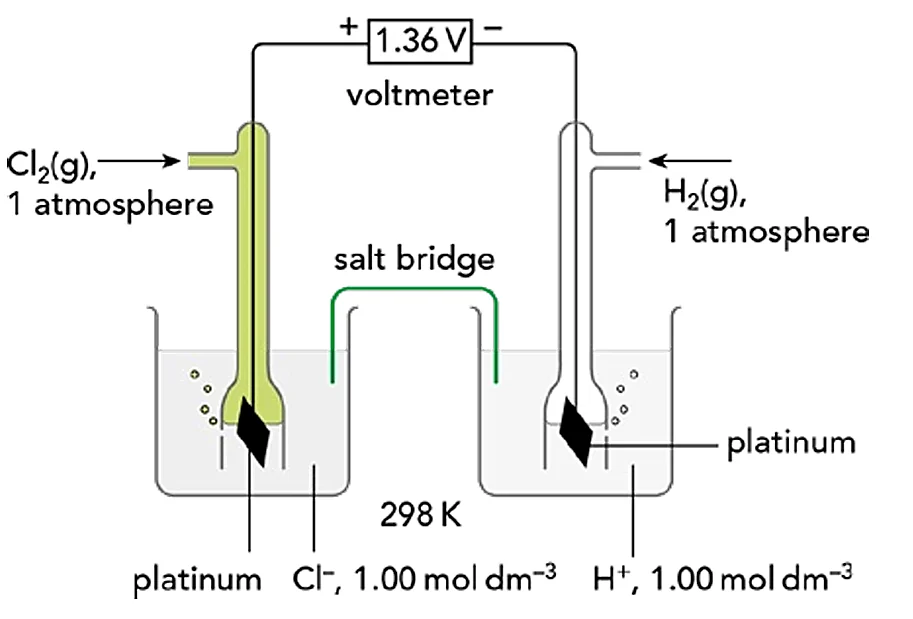
Measured relative to the Standard Hydrogen Electrode (Pt|H2(101 kPa)|H+(1 mol dm−3)) at 298 K. Salt bridge: KNO3(aq).

Chlorine half-cell connected by a salt bridge to a standard hydrogen electrode
Connect the unknown half-cell to the standard hydrogen electrode. Platinum provides an inert surface, while the salt bridge completes the circuit without mixing the solutions directly.
  • More positive E° → stronger oxidising agent (reduced more readily).
  • More negative E° → stronger reducing agent.

24.3 Cell EMF and Feasibility

E°cell = E°(more positive) − E°(more negative)

Reaction feasible if E°cell > 0. Electrons flow externally from more negative (anode, oxidised) to more positive (cathode, reduced).

ΔG° = −nFE°cell

24.4 Nernst Equation

E = E° + (0.059/z) lg([oxidised]/[reduced])
How to read the equation at 298 K:
  • More oxidised form → [oxidised]/[reduced] gets larger → E becomes more positive → reduction is favoured.
  • More reduced form → [oxidised]/[reduced] gets smaller → E becomes more negative.
Why a positive cell EMF is feasibleE°cell > 0 ⇒ −nFE°cell < 0 ⇒ ΔG° < 0 ⇒ feasible
Remember the minus sign: ΔG° = −nFE°cell, not +nFE°cell. Both n and F are always positive.

24.5 Predicting Electrolysis Products

Molten binary salts: metal at the cathode, non-metal at the anode. In aqueous solution, water can be discharged: H2 at the cathode if the metal is more reactive than hydrogen; O2 at the anode unless concentrated halide is present (then Cl2/Br2/I2). Dilute vs concentrated NaCl is a standard contrast.

F = Le   Q = It   moles of e = Q/F

Avogadro's constant can be found by measuring the mass of metal deposited and the charge passed.

25Equilibria (A2)

pH calculations, Ka, buffers, solubility product Ksp and partition coefficient.

25.1 pH

pH = −lg[H+] | [H+] = 10−pH | Kw = [H+][OH] = 1.00 × 10⁻¹⁴ at 298 K
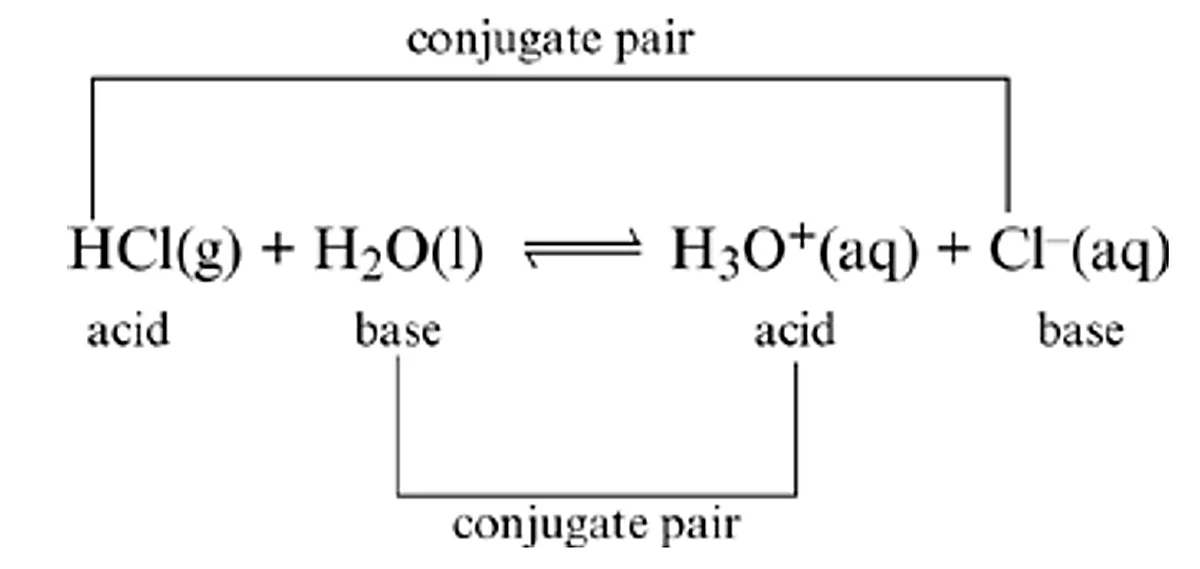
Hydrogen chloride and water forming hydronium and chloride with conjugate pairs marked
Conjugate acid-base pairs differ by exactly one H+: HCl/Cl and H2O/H3O+.

25.2 Weak Acids

Ka = [H+][A]/[HA] | [H+] ≈ √(Ka × [HA]) | pKa = −lg Ka

25.3 Buffers

A solution that resists pH change when small amounts of acid or base are added. Acidic buffer: weak acid + its salt (e.g. CH3COOH + CH3COONa).
Henderson-HasselbalchpH = pKa + lg ([A]/[HA])

Action: A + H+ → HA absorbs added H+; HA + OH → A + H2O absorbs added OH. Blood: H2CO3/HCO3 buffer keeps pH ~7.4.

25.4 Solubility Product

Ksp = [Mn+]a[Xm−]b (units depend on stoichiometry)

If ionic product > Ksp — precipitate forms. Common ion effect: adding a common ion reduces solubility.

25.5 Partition Coefficient Kpc

Kpc = [solute in solvent 1] / [solute in solvent 2]

Constant at fixed T; depends on relative polarities. Used to model solvent extraction.

25.6 Calculations

pH = −lg[H+]; Kw = [H+][OH] = 1.00×10⁻¹⁴ at 298 K. Strong acid: [H+] = concentration. Strong alkali: [OH] = concentration, then [H+] = Kw/[OH]. Weak acid: [H+] = √(Ka × c) if α is small. A buffer is a weak acid + its salt (or weak base + salt); added H+ is removed by A, added OH by HA. Ksp = product of aqueous ion concentrations raised to stoichiometric powers — solids omitted.

26Reaction Kinetics (A2)

Rate equations, order, half-life, rate-determining step and types of catalysis.

26.1 Rate Equation

rate = k[A]m[B]n

m, n found experimentally, not from stoichiometry. Overall order = m + n.

26.2 Orders

Order[A] vs tt1/2Useful plot
ZeroStraight (gradient = −k)Depends on [A]0[A] vs t
FirstCurve, constant t1/20.693/kln[A] vs t (gradient = −k)
SecondCurve, t1/2 increases as time passes1/(k[A]0)1/[A] vs t (gradient = +k)
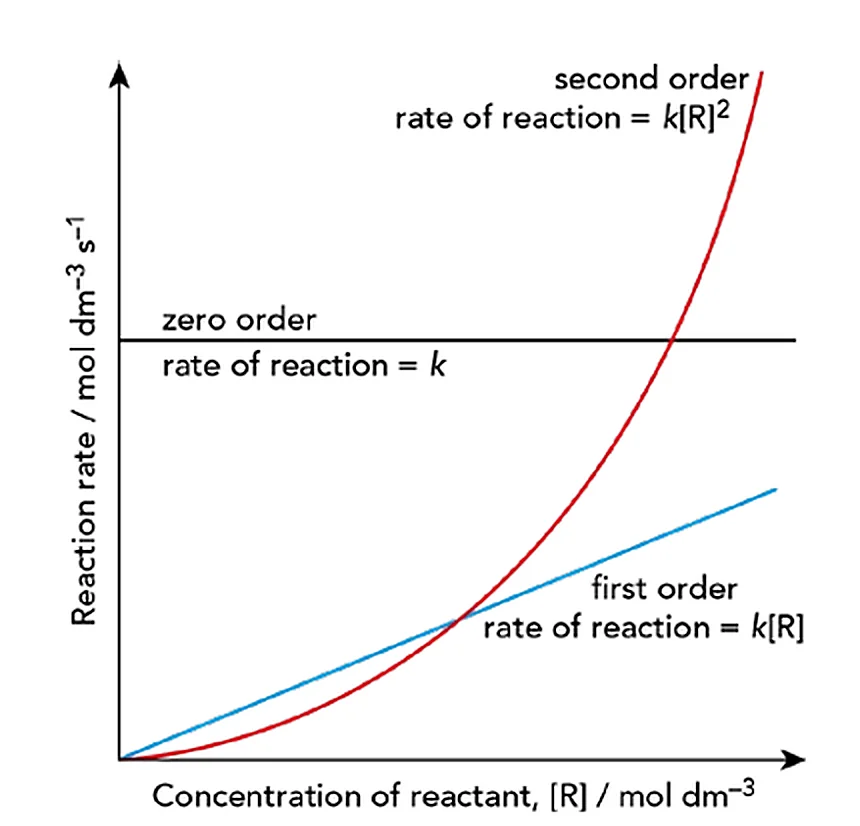
Rate against concentration curves for zero-order, first-order and second-order reactions
On a rate-versus-concentration graph: zero order is horizontal, first order is linear through the origin, and second order curves upward.

26.3 Rate-Determining Step

The slowest step in a mechanism. Only species in the rds (or before it) appear in the rate equation. Mechanism must be consistent with: overall equation; rate equation; rds slowness.

26.4 Arrhenius Equation

k = Ae−Ea/RT | ln k = ln A − Ea / RT

Plot ln k vs 1/T gives gradient = −Ea/R, intercept = ln A. Larger Ea → smaller k at a given T; higher T → larger k.

The exponential term dominates: a small increase in T produces a large increase in k because the fraction of molecules with E ≥ Ea rises exponentially.

26.5 Catalysis

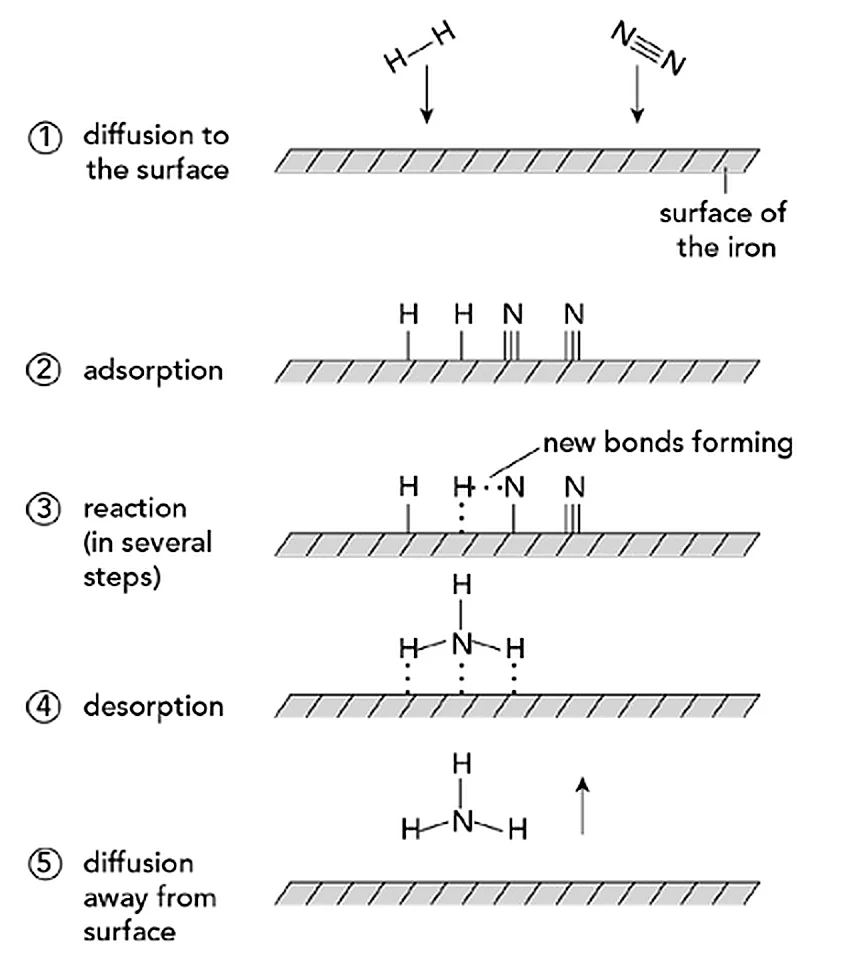
  • Heterogeneous: different phase; adsorption → bond weakening → reaction → desorption. e.g. Fe in Haber, V2O5 in Contact, Pt/Rh in catalytic converters.
  • Homogeneous: same phase; forms intermediate then regenerated. e.g. Fe2+/Fe3+ catalysing I + S2O82−.
Diffusion, adsorption, surface reaction, desorption and diffusion in iron-catalysed ammonia formation
Heterogeneous catalysis proceeds by diffusion to the surface, adsorption and bond weakening, reaction on active sites, desorption, then diffusion away.

26.6 First-Order Half-Life and Finding Orders

For a first-order reaction t1/2 is constant and k = ln 2 / t1/2. Orders come from initial-rate data (how rate changes when one [ ] is doubled) or from a concentration–time shape (zero: straight; first: constant half-life). The rate-determining step's molecularity must match the rate equation; intermediates formed in fast steps before the r.d.s. can appear in the rate equation after substitution.

27Group 2 (A2 — Explanations)

Thermal stability and solubility trends explained quantitatively using ionic radius and charge density.

27.1 Thermal Stability of Nitrates and Carbonates

Stability increases down the group. The cation's polarising power = charge / radius2; smaller cations distort the anion's electron cloud, weakening the internal bond, and decomposition occurs at lower T.

CompoundMgCaSrBa
Carbonate decomposition T~540 °C~900 °C~1290 °C~1360 °C
Nitrate decomposition T~450 °C~560 °C~570 °C~590 °C

Group 2 carbonates: MCO3 → MO + CO2. Nitrates (except Ba): 2M(NO3)2 → 2MO + 4NO2 + O2. Ba(NO3)2 → Ba(NO2)2 + O2 (only Ba gives nitrite not oxide).

The higher the charge density of the cation, the greater the polarising power — Mg2+ has the highest charge density in Group 2, so its compounds decompose at the lowest temperatures.

27.2 Solubility Explained by ΔHsol

ΔHsol = −ΔHlatt + ΣΔHhyd. For hydroxides, ΔHlatt falls faster than ΔHhyd down the group → ΔHsol more exothermic → more soluble. For sulfates, ΔHhyd falls faster than ΔHlatt → less soluble.

Key exam comparison
BaSO4 is insoluble — basis of the sulfate ion test (BaCl2 + H+ gives white ppt). MgSO4 and CaSO4 are soluble.
Mg(OH)2 is sparingly soluble (milk of magnesia); Ba(OH)2 is much more soluble → stronger alkaline solution.

28Chemistry of Transition Elements

d-block: variable oxidation states, coloured complexes, ligands, d-orbital splitting, and stability constants.

28.1 Definition

A transition element is a d-block element that forms at least one stable ion with an incomplete d sub-shell. Excludes Sc (only Sc3+ = d0) and Zn (Zn2+ = d10).

28.2 Characteristic Properties

  1. Variable oxidation states — 3d and 4s electrons are similar in energy.
  2. Catalytic behaviour — vacant d orbitals; ability to change oxidation state.
  3. Form complex ions — vacant d orbitals accept lone pairs from ligands.
  4. Form coloured compounds — d-d electronic transitions absorb visible light.

28.3 Complex Ions and Ligands

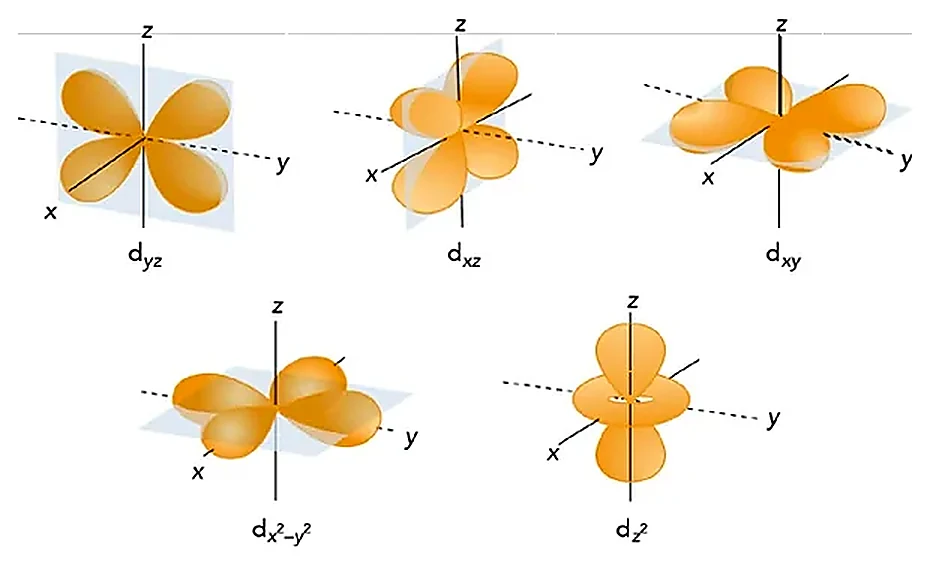
Shapes and orientations of the five d orbitals
The five d orbitals have different orientations relative to approaching ligands; this determines how their energies split in a complex.
  • Ligand: a species with at least one lone pair donating to a metal ion via a dative bond.
  • Monodentate: H2O, NH3, Cl, CN.
  • Bidentate: en (1,2-diaminoethane), C2O42−.
  • Hexadentate: EDTA4− (ethylenediaminetetraacetate) — forms very stable 1:1 complexes via the chelate effect.
  • Coordination number 6 — octahedral; 4 — tetrahedral or square planar; 2 — linear.

28.4 Colour — d-Orbital Splitting

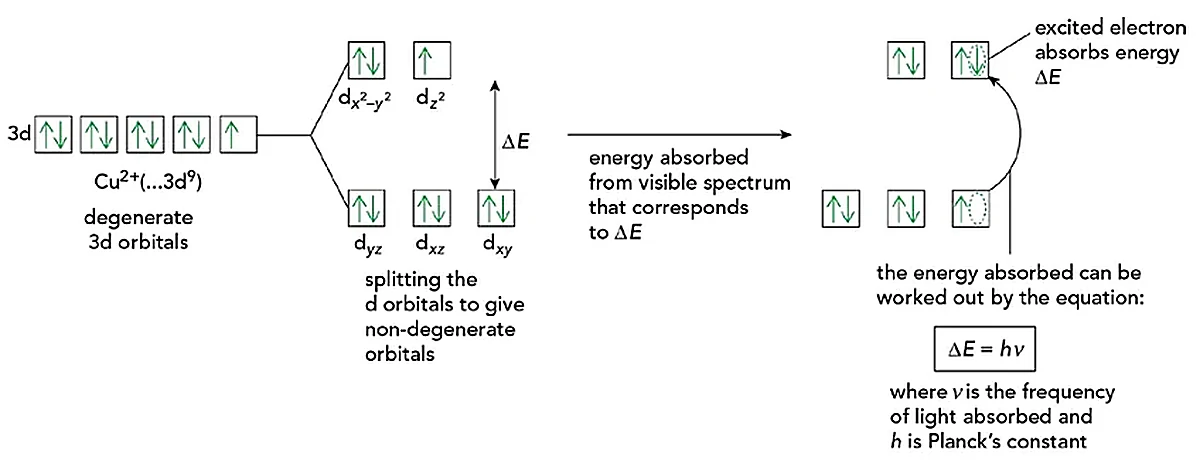
In an octahedral field, the 5 d orbitals split into 2 higher (eg) and 3 lower (t2g) by energy ΔE. An electron absorbs a photon of energy hf = ΔE — complementary colour seen.

Ligand strength affects ΔE: I < Cl < F < H2O < NH3 < CN.

Octahedral d orbital splitting and visible-light absorption
Octahedral splitting creates two energy levels. Absorption of visible light promotes an electron across ΔE; the complementary colour is observed.
Example
[Cu(H2O)6]2+ pale blue + excess NH3 → [Cu(NH3)4(H2O)2]2+ deep blue (ligand exchange).

28.5 Key Redox Reactions

2Cu2+ + 4I → 2CuI(s, white) + I2  (redox evidence; I2 turns starch blue)
MnO4 + 8H+ + 5Fe2+ → Mn2+ + 4H2O + 5Fe3+  (purple → colourless titration)
2MnO4 + 16H+ + 5C2O42− → 2Mn2+ + 8H2O + 10CO2  (slow at start, autocatalysed by Mn2+)

28.6 Stability Constant Kstab

The equilibrium constant for the formation of a complex from its constituent ions/molecules in solution. Larger Kstab — more stable complex (favours ligand exchange).

EDTA forms very stable 1:1 complexes (chelate effect): one EDTA replacing six H2O ligands releases 6 mol of H2O → ΔS positive → ΔG more negative.

28.7 Stereoisomerism in Complexes

  • Cis/trans in square planar [Pt(NH3)2Cl2]: cis is anti-cancer drug cisplatin; trans is inactive.
  • Optical isomers in octahedral complexes with 3 bidentate ligands, e.g. [Ni(en)3]2+.

28.8 Catalysis and Variable Oxidation States

Transition elements have an incomplete d subshell in the atom or a common ion. Variable oxidation states let them catalyse redox (e.g. Fe2+/Fe3+, MnO2 for H2O2, V2O5 in Contact). Ligands are Lewis bases; denticity is the number of donor atoms (en is bidentate, EDTA4− hexadentate). Colour arises when a d–d transition absorbs visible light — the complementary colour is seen. A ligand change or oxidation-state change changes Δ and therefore the colour.

29Introduction to A2 Organic Chemistry

Additional functional groups, aromatic chemistry, and reactivity considerations that extend AS knowledge.

29.1 New Functional Groups (A2)

At A2 you need to recognise and name compounds containing these additional functional groups:

Functional groupGeneral formulaExample
Arene (benzene ring)C6H5-benzene, methylbenzene
HalogenoareneC6H5-Xchlorobenzene, bromobenzene
PhenolC6H5-OHphenol
Acyl chlorideRCOClethanoyl chloride
AmideRCONH2ethanamide
Amino acidH2N-CHR-COOHglycine, alanine
Azo (diazo)-N=N-azobenzene dyes

29.2 Key Reactivity Patterns

  • Benzene vs alkenes: Benzene undergoes electrophilic substitution (aromaticity preserved); alkenes undergo electrophilic addition. The delocalised π system in benzene is more stable than isolated C=C bonds.
  • Phenol reactivity: The -OH group donates electron density into the ring via resonance — phenol is more reactive than benzene towards electrophiles (e.g. reacts with Br2(aq) without catalyst).
  • Acyl chlorides: Most reactive carboxylic acid derivative due to strongly polar C=O and excellent leaving group (Cl). Reacts with H2O, alcohols, phenols and amines via addition-elimination.
  • Amides: Much less reactive than acyl chlorides; the N lone pair is delocalised into the C=O bond, reducing electrophilicity of the carbonyl carbon.

29.3 Bonding and Hybridisation (A2 Review)

Review of AS hybridisation with A2 extensions:

HybridGeometryAngleExample
sp3Tetrahedral109.5°CH4, C-OH in alcohols
sp2Trigonal planar120°C=C, C=O, benzene ring carbons
spLinear180°C≡C, C≡N

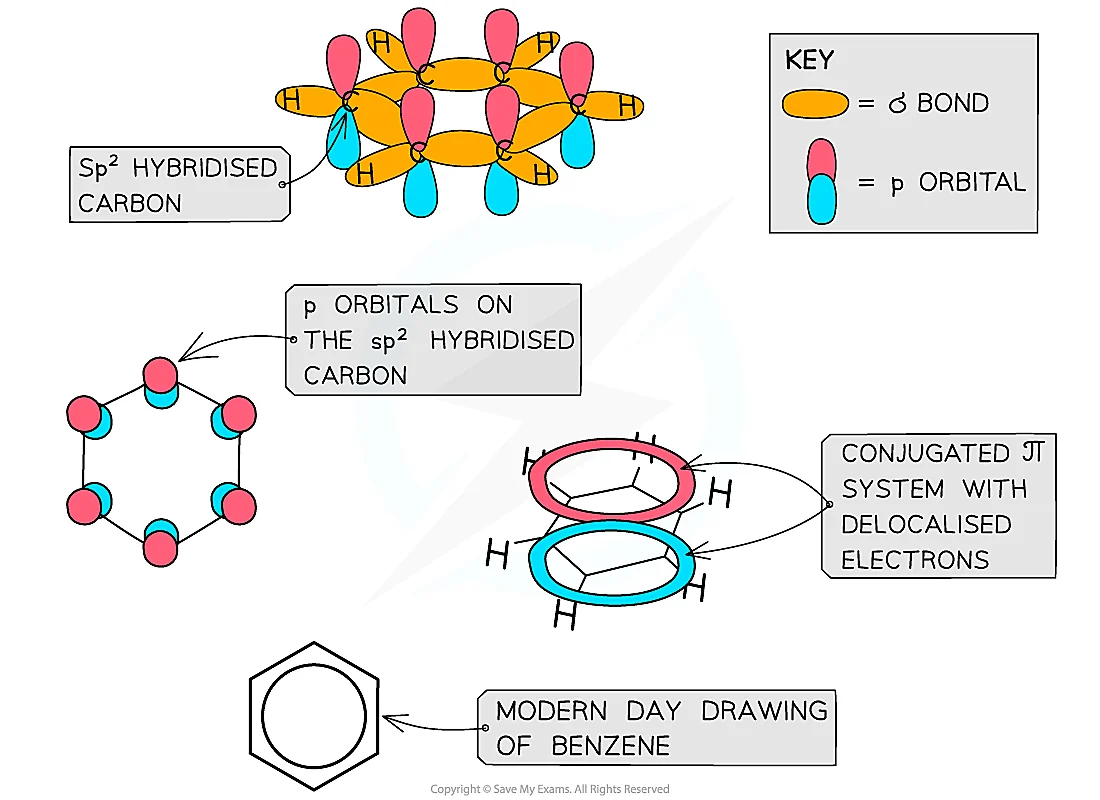
In benzene, each C is sp2 hybridised. The remaining p orbital on each C overlaps side-on with neighbours to form a delocalised π system of 6 electrons above and below the ring plane.

30Arenes (Benzene Chemistry)

Delocalised structure, electrophilic substitution (nitration, halogenation, Friedel-Crafts), directing effects, and side-chain oxidation.

30.1 Structure of Benzene

Six sp2 carbons; planar regular hexagon; delocalised π system above and below the ring (6 π electrons). All C-C bond lengths equal (~140 pm); intermediate between single (154) and double (134).

Evidence: enthalpy of hydrogenation of benzene is less exothermic than predicted for "1,3,5-cyclohexatriene" by ~150 kJ mol−1 — aromatic stabilisation.

Benzene sigma framework and overlapping p orbitals forming delocalised pi clouds above and below the ring
Each sp2 carbon retains one p orbital. Sideways overlap around the entire ring creates delocalised π electron density above and below the plane.

30.2 Electrophilic Substitution Mechanism

  1. Form the electrophile.
  2. Electrophile attacks the π system — curly arrow from ring to E+.
  3. Arenium intermediate (carbocation with disrupted aromaticity, drawn as a partial circle with a + inside).
  4. H+ leaves — aromaticity restored.

30.3 Key Reactions

ReactionReagents / conditionsElectrophile
Nitrationconc. HNO3 + conc. H2SO4, 25-60 °CNO2+
HalogenationCl2 / AlCl3 (or Br2 / FeBr3)Cl+ / Br+
Friedel-Crafts alkylationR-Cl / AlCl3R+
Friedel-Crafts acylationRCOCl / AlCl3RCO+

30.4 Directing Effects

  • 2,4-directors (activating): -OH, -NH2, -NHR, -OR, -R (alkyl). Increase ring electron density.
  • 3-directors (deactivating): -NO2, -COOH, -CHO, -COR, -SO3H. Withdraw electron density.

30.5 Side-chain Oxidation

Hot alkaline KMnO4 then H+ converts R-C6H5 to benzoic acid (regardless of side-chain length, provided it has at least one benzylic H).

30.6 Benzene Reactions — Conditions

  • Nitration: conc. HNO3 + conc. H2SO4, ~55 °C. Electrophile NO2+.
  • Halogenation: Cl2 / AlCl3 or FeCl3, r.t.
  • Friedel–Crafts alkylation / acylation: RCl or RCOCl / AlCl3.
  • Side-chain oxidation of any alkylbenzene with alkaline KMnO4 then acid → benzoic acid (needs a benzylic H).

Benzene does not decolorise Br2(aq) and does not react with H2 without a catalyst — evidence against a Kekulé cyclohexatriene.

31Halogenoarenes

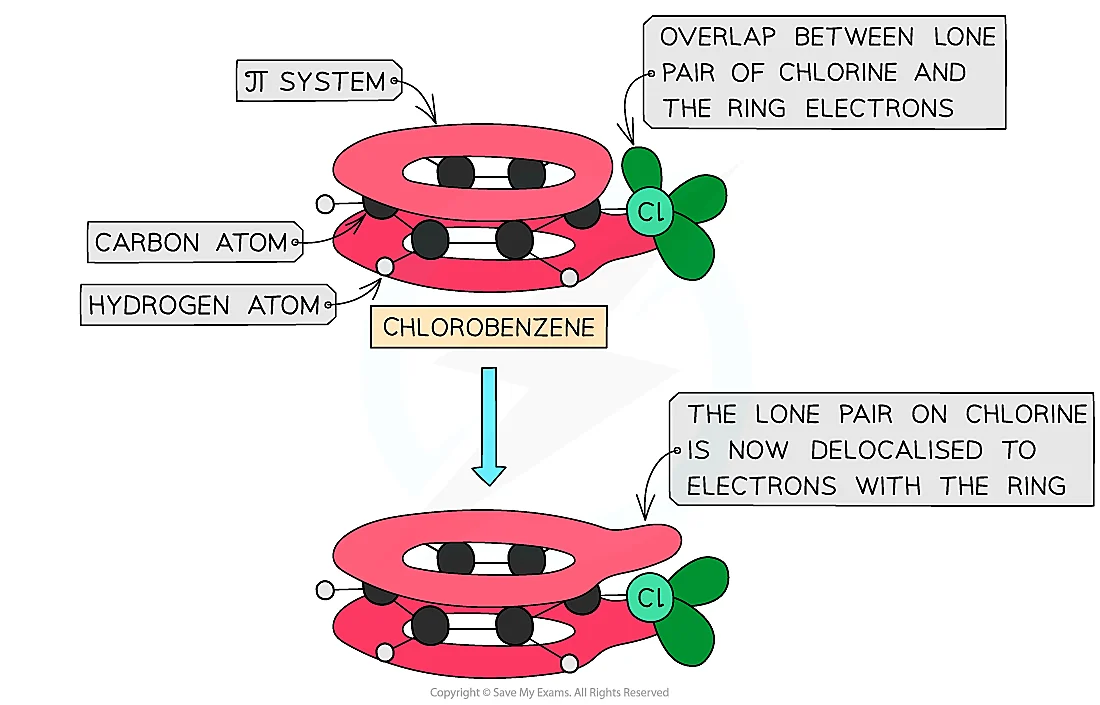
Unreactivity of aryl halides compared with alkyl halides — explained by overlap of a halogen lone pair with the ring π system.

31.1 Structure and Bonding

In halogenoarenes (e.g. chlorobenzene, bromobenzene), the halogen atom is directly bonded to a carbon of the benzene ring. The C-X bond is shorter and stronger than in halogenoalkanes.

31.2 Unreactivity towards Nucleophiles

Chlorobenzene does not react with aqueous NaOH (unlike chloroethane, which readily hydrolyses). Two reasons explain this:

  1. Lone pair delocalisation: A lone pair on the halogen atom overlaps with the ring π system, giving partial double-bond character in the C-X bond. This shortens and strengthens the C-X bond, making it harder to break.
  2. Electron repulsion: The delocalised π electron cloud of the ring repels approaching nucleophiles, hindering attack at the carbon.
Chlorine lone-pair overlap with the benzene pi system producing partial double-bond character
A chlorine lone pair overlaps with the ring π system. The resulting partial double-bond character shortens and strengthens C-Cl, so nucleophilic substitution is difficult.

31.3 Comparison with Halogenoalkanes

FeatureHalogenoalkane (e.g. C2H5Cl)Halogenoarene (e.g. C6H5Cl)
C-X bond lengthLongerShorter (partial double bond character)
C-X bond strengthWeakerStronger
Reaction with NaOH(aq)Readily hydrolysesNo reaction
MechanismSN1 or SN2Not applicable under normal conditions

31.4 Side-chain Halogenation

When alkylbenzenes are treated with Cl2 or Br2 in the presence of UV light, substitution occurs in the side-chain (not the ring) by a free-radical mechanism. This produces halogenoalkylbenzenes (e.g. C6H5CH2Cl from methylbenzene).

C6H5CH3 + Cl2 → C6H5CH2Cl + HCluv light, side-chain substitution
This is a useful distinction: halogenation in the ring requires AlCl3/FeBr3 catalyst (electrophilic substitution); halogenation in the side-chain requires UV light (free-radical substitution).

32Phenol

Acidity compared with ethanol and carboxylic acids, and activated-ring substitution.

32.1 Acidity

Phenol is more acidic than ethanol because the phenoxide ion is stabilised by delocalisation of the negative charge into the ring. It is less acidic than a carboxylic acid, where the charge is shared by two oxygen atoms. Phenol dissolves in NaOH(aq) but not in Na2CO3(aq) — a standard test against carboxylic acids.

32.2 Reactions of the −OH Group

  • Na(s) → sodium phenoxide + H2.
  • NaOH(aq) → sodium phenoxide + H2O.
  • No reaction with carbonates.

32.3 Electrophilic Substitution

The OH group activates the ring and directs 2- and 4-. Phenol decolorises Br2(aq) at room temperature with no catalyst, giving a white ppt of 2,4,6-tribromophenol and HBr. Dilute HNO3 gives a mixture of 2- and 4-nitrophenol.

C6H5OH + 3Br2 → C6H2Br3OH + 3HBr

32.4 Azo Coupling

Phenoxide + benzenediazonium chloride in alkali below 10 °C → orange/yellow azo dye. The −N=N− link is the chromophore. Used in dyes and as a qualitative test for a phenol.

33Acyl Chlorides

Why they are the most reactive carboxylic-acid derivatives, and the addition–elimination mechanism.

33.1 Reactivity

The carbonyl carbon is strongly δ+ and Cl is a good leaving group. Reactivity order: acyl chloride > acid anhydride > ester > amide. Acyl chlorides fume in moist air (HCl).

33.2 Key Reactions (room temperature, often vigorous)

NucleophileOrganic productInorganic product
H2Ocarboxylic acidHCl
ROHesterHCl
phenol / NaOHaryl esterHCl / NaCl
NH3 (excess)primary amideNH4Cl
RNH2N-substituted amideRNH3Cl

33.3 Addition–Elimination

  1. Nucleophile attacks the δ+ carbonyl carbon; the C=O π bond breaks onto oxygen (tetrahedral intermediate).
  2. The C=O bond reforms and Cl leaves.
  3. A proton is lost if the nucleophile was neutral.

Compared with carboxylic acids, no heat or conc. acid is needed, and the reactions go to completion because HCl leaves.

34Nitrogen Compounds (A2)

Aliphatic and aromatic amines, amides, diazonium salts, and amino acids.

34.1 Basicity of Amines

Order: ethylamine > ammonia > phenylamine.

  • Ethylamine: alkyl group is electron-donating (+I) — lone pair more available.
  • Phenylamine: lone pair delocalised into ring — less available; weaker base.

34.2 Production of Amines

  • RX + NH3 in ethanol, heat, pressure → R-NH2.
  • LiAlH4 on nitrile → R-CH2NH2; on amide → R-CH2NH2.
  • Nitrobenzene + Sn / conc. HCl, reflux, then NaOH(aq) — phenylamine.

34.3 Diazonium Salts and Azo Dyes

Phenylamine + NaNO2 / dil. HCl below 10 °C → C6H5N2+Cl (benzenediazonium chloride). Reaction with phenol in NaOH(aq) → orange azo dye (R-N=N-R').

34.4 Amides

Weaker base than amines (N lone pair delocalised into C=O). Hydrolysis with dil. H+ or OH + heat → carboxylic acid + amine. LiAlH4 reduction → amine.

34.5 Amino Acids

Have -NH2 and -COOH on the same C. Form a zwitterion internally (-NH3+ and -COO).

Isoelectric point: the pH at which the net charge on the molecule is zero.
  • Low pH: -NH3+ form → migrates to cathode.
  • High pH: -COO form — migrates to anode.
  • Peptide bond (-CO-NH-) formed by condensation between -COOH and -NH2 of two amino acids.

34.6 Amino Acids and Amides in More Detail

α-Amino acids exist as zwitterions in the solid and at the isoelectric pH. In acid they are cations; in alkali, anions. They join by condensation to peptides. Amides are neutral (the lone pair is delocalised onto the C=O). Hydrolysis of an amide (acid or alkali, heat) recovers the carboxylic acid (or salt) and the amine (or ammonium salt).

35Condensation Polymerisation

Polyesters, polyamides, repeating units and why they can be hydrolysed.

35.1 Polyesters

A diol + a dicarboxylic acid (or dioyl chloride) lose H2O (or HCl) at each link. Terylene / PET is benzene-1,4-dicarboxylic acid + ethane-1,2-diol. The repeating unit contains the ester −COO− group.

35.2 Polyamides

A diamine + a dicarboxylic acid (or dioyl chloride) give a polyamide. Nylon-6,6 is hexane-1,6-diamine + hexanedioic acid. Kevlar uses 1,4-aromatic monomers and hydrogen-bonds between chains, giving high tensile strength. Proteins are natural polyamides (peptide bonds).

35.3 Predicting the Repeating Unit

Remove H from each −OH or −NH2 and OH from each −COOH (or Cl from an acyl chloride) and join the remainders. For a single amino acid or hydroxy-acid, the monomer already contains both functional groups.

35.4 Biodegradability

Ester and amide links can be hydrolysed by acid, alkali or enzymes, so polyesters and polyamides are potentially biodegradable. Addition polymers have a C−C backbone that is not easily hydrolysed.

36Organic Synthesis (A2)

Designing multi-step routes for aromatic and chiral molecules; retrosynthetic analysis and pharmaceutical synthesis.

36.1 Synthetic Strategy

Good synthesis planning requires careful consideration of:

  1. Functional group interconversions: match target functional groups with known transformations from the reagent list.
  2. Regioselectivity: in aromatic chemistry, directing effects determine where new groups attach (e.g. nitration of methylbenzene — 2-nitromethylbenzene and 4-nitromethylbenzene).
  3. Stereoselectivity: consider chirality when creating or modifying chiral centres. Markovnikov addition, SN2 inversion, and HCN addition to carbonyls all create defined stereochemistry.
  4. Order of steps: install reactive groups at the appropriate stage. For example, nitration of methylbenzene is done before oxidising the side-chain to COOH, because -COOH is a 3-director (meta-directing) while -CH3 is a 2,4-director.
  5. Protecting groups: sometimes a reactive group must be protected before another reaction. For example, -NH2 can be acetylated to -NHCOCH3 before nitration, then hydrolysed back afterwards.

36.2 Key A2 Synthetic Routes

TargetRouteKey reagents
Benzoic acid from methylbenzeneSide-chain oxidationKMnO4 / OH, reflux; then H+
Phenylamine from methylbenzeneCH3 → COOH → NO2 → NH2KMnO4; conc. HNO3/H2SO4; Sn/HCl
2,4,6-tribromophenol from phenolDirect bromination (no catalyst needed)Br2(aq), room temp
Nylon-6,6 from adipic acidDicarboxylic acid + diamineHeat, condensation
Aspirin from salicylic acidAcylation of -OH(CH3CO)2O or CH3COCl
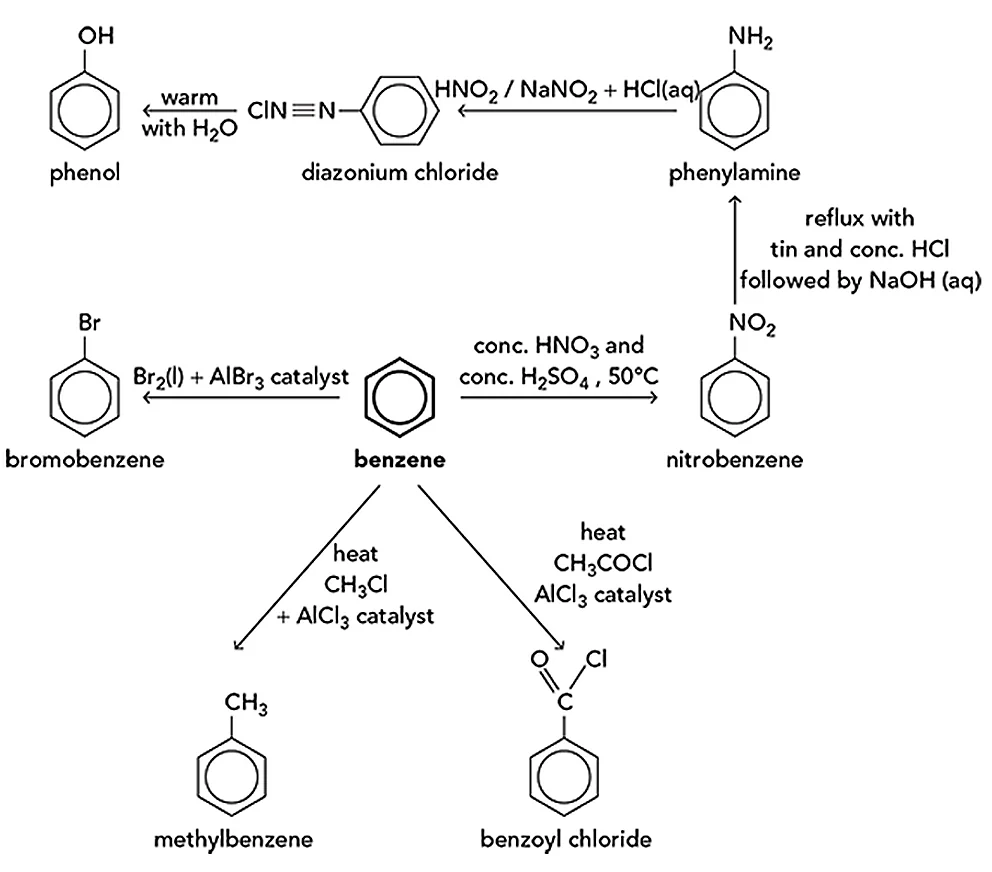
Reaction map connecting benzene, bromobenzene, methylbenzene, benzoic acid, nitrobenzene, phenylamine and phenol
Use the map as a route-planning model: work backwards from the target, label every arrow with reagent and conditions, and check that directing effects permit the required substitution position.

36.3 Chiral Synthesis and Pharmaceuticals

Many drugs are chiral, and enantiomers can have very different biological effects:

  • Thalidomide: one enantiomer treats morning sickness; the other causes birth defects. Racemic mixture was dangerous.
  • Ibuprofen: only the (S)-enantiomer is active; the (R)-enantiomer is inactive (but converts slowly in the body).
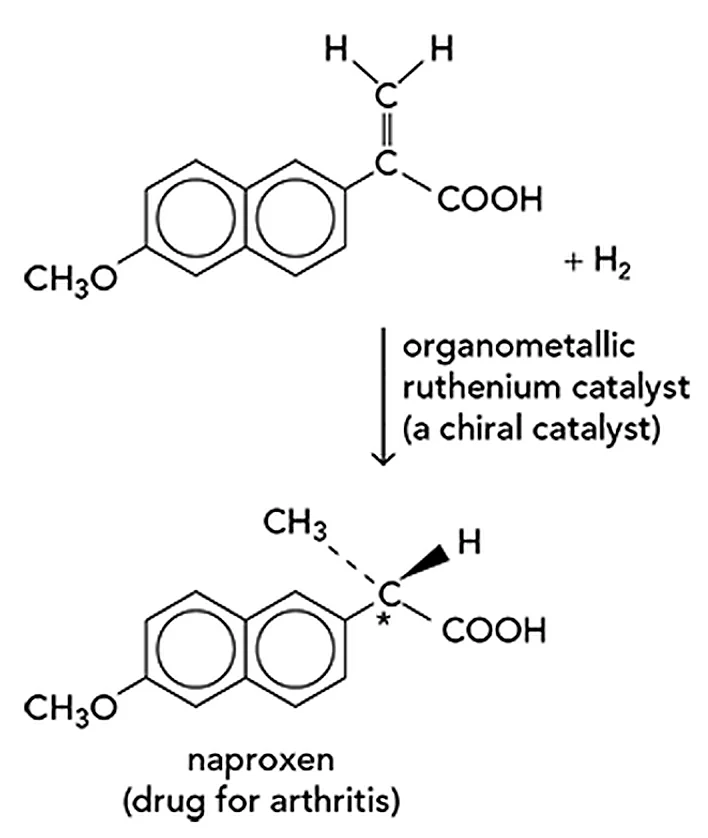
Asymmetric hydrogenation creating one chiral form of naproxen using a chiral catalyst
A chiral catalyst creates one enantiomer preferentially when a planar group is converted into a tetrahedral stereocentre, reducing the need to separate a racemic mixture.

Methods to obtain single enantiomers:

  1. Chiral catalysis: use a chiral catalyst or enzyme to favour one enantiomer (e.g. asymmetric hydrogenation).
  2. Resolution: convert a racemic mixture into diastereomers (e.g. by reacting with a single enantiomer of a chiral acid), separate by crystallisation, then regenerate the original enantiomers.
  3. Chiral pool synthesis: start from a naturally occurring chiral compound (e.g. amino acids, sugars).
In exam questions, always state whether a chiral centre is created, destroyed, or preserved at each step. If a new chiral centre is formed from a planar intermediate (e.g. C=O + HCN), a racemic mixture is produced.

37Analytical Techniques (A2 — TLC, GLC, NMR)

Chromatographic separation and 1H / 13C NMR for structure determination.

37.1 Thin-Layer Chromatography (TLC)

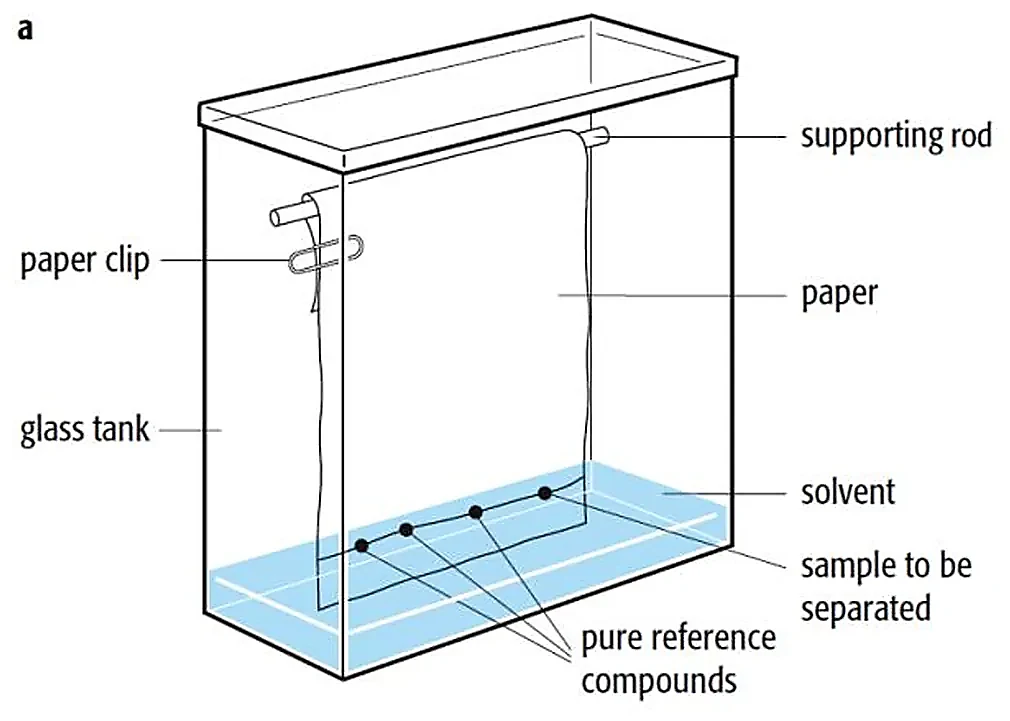
Chromatography chamber with baseline, solvent and reference spots labelled
Chromatography setup: the baseline and sample spots must start above the solvent level, and the solvent front is marked immediately after removal.

Stationary phase: thin layer of silica (or Al2O3) on a plate, polar. Mobile phase: non-polar solvent. Spots visualised under UV or with iodine.

Rf = distance moved by spot / distance moved by solvent front

More polar compound — greater interaction with stationary phase — lower Rf.

37.2 Gas-Liquid Chromatography (GLC)

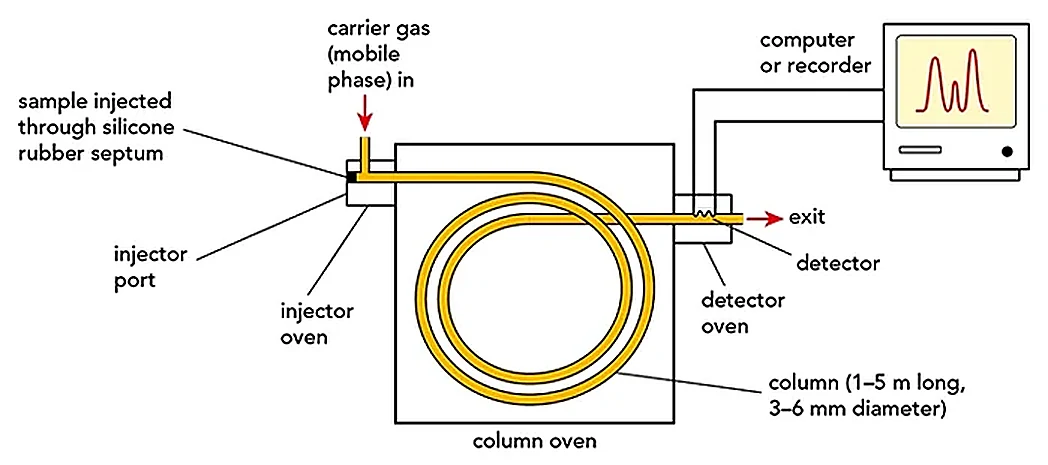
Gas-liquid chromatography instrument showing injector, column, carrier gas and detector
GLC apparatus: an inert carrier gas moves the vaporised sample through a coated column to a detector and recorder.

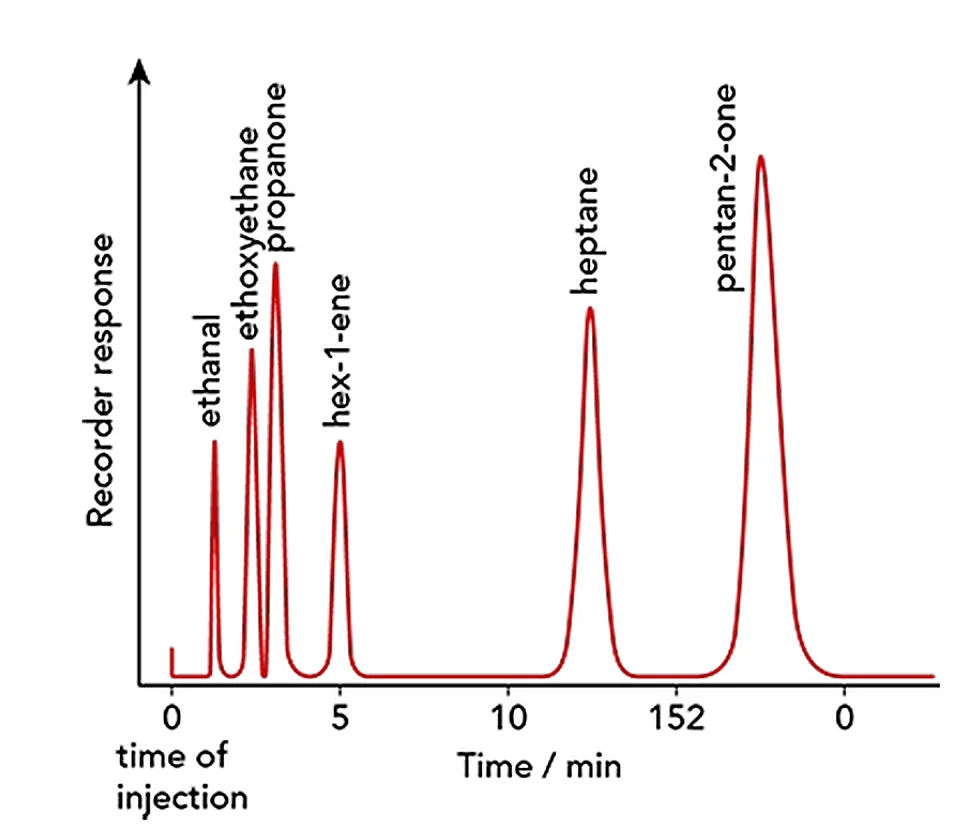
Stationary phase: high-boiling-point non-polar liquid on a solid support. Mobile phase: unreactive carrier gas (N2, He). Retention time identifies component; area under peak ∝ amount.

Gas chromatogram with separated peaks at different retention times
Each peak appears at a characteristic retention time. Peak position helps identify a component; integrated peak area is proportional to its amount.

37.3 13C NMR

Number of peaks = number of distinct C environments. Chemical shifts:

Environmentδ / ppm
sp3 alkyl0-50
C-O / C-N50-90
sp2 C=C / arene110-160
C=O (carbonyl)190-220
Carbon-13 NMR spectrum of propylbenzene with its distinct carbon environments indicated
Each chemically distinct carbon environment gives one 13C signal. Symmetry can make several carbon atoms equivalent and reduce the number of peaks.

37.4 1H NMR

Low resolution proton NMR spectrum with signals integrating to one, two and three hydrogens
Low-resolution 1H NMR: chemical shift identifies the environment, while relative peak area gives the 1H:2H:3H proton ratio.
  • Reference: TMS (δ = 0). Solvent: CDCl3 (no H interfering).
  • Each signal = different H environment.
  • Integration — number of H in that environment.
  • n+1 rule: n equivalent H on adjacent C → n+1 peaks (singlet, doublet, triplet, quartet…).
  • D2O shake: O-H and N-H protons exchange — peak disappears.
Environmentδ / ppm
R-CH3, -CH2-0.9-1.7
CH adjacent to C=O2.2-3.0
CH adjacent to O / halogen3.2-4.0
=CH (alkene)4.5-6.0
Ar-H6.0-9.0
RCHO (aldehyde)9.3-10.5
RCOOH9.0-13.0 (broad)
Common error: applying n+1 to H on the same carbon. Only count H on adjacent carbons.

37.5 Reading an NMR Spectrum

  • TMS is the zero reference. Chemical shift tells the environment (near O or a C=O is more downfield).
  • 1H integration (peak area) is the proton ratio.
  • Splitting: n+1 rule from non-equivalent neighbouring protons. A singlet has no such neighbours.
  • 13C counts different carbon environments; it is not split by H in the usual decoupled spectrum.
  • TLC: Rf = distance spot / distance solvent. GLC: retention time identifies; peak area is amount.

...Data, Constants and Exam Information

Reference cards for the AS & A Level examinations.

A2 revision guide exam boosters

A2 areaExam-useful detailCommon trap
Lattice energy and Born-Haber cyclesDefine lattice energy with gaseous ions and one mole of ionic solid. Use atomisation, first/second ionisation energy, electron affinity, enthalpy of formation and lattice energy with arrows in the correct direction.Using aqueous ions in a lattice-energy definition, or forgetting that the second electron affinity of oxygen is endothermic.
Entropy and Gibbs free energyΔG = ΔH - TΔS. Convert ΔS from J K-1 mol-1 to kJ K-1 mol-1 when ΔH is in kJ mol-1. Feasible means ΔG < 0.Mixing units or saying a feasible reaction must be fast; feasibility is thermodynamic, not kinetic.
Electrode potentialsMore positive E° values favour reduction. E°cell = E°right - E°left, or cathode minus anode.Changing the sign of E° when multiplying a half-equation; electrode potentials are not multiplied.
A2 kineticsOrders come only from experimental data. Units of k depend on overall order. The rate-determining step must contain the species that appear in the rate equation, possibly after replacing intermediates.Deducing rate order from stoichiometric coefficients in the overall equation.
Transition elementsVariable oxidation states, coloured complexes, ligand exchange and catalysis come from partially filled d orbitals and close 3d/4s energy levels.Calling Zn a transition element in 9701 definitions; Zn forms Zn2+ with full 3d10.
NMR and chromatographyUse number of peaks for environments, integration for relative proton count, splitting for adjacent H atoms, and D2O exchange for O-H/N-H. In chromatography, retention time identifies; peak area estimates amount.Applying the n+1 rule to hydrogens on the same carbon instead of adjacent carbons.

A2 organic synthesis checklist

  • Work backwards: identify the target functional group, then choose the immediate precursor with a known reagent set.
  • Count carbons: CN- substitution and Friedel-Crafts acylation can extend the carbon skeleton; many oxidations and reductions do not.
  • Control ring position: alkyl and hydroxy groups direct mainly 2,4; nitro, carboxyl and acyl groups direct mainly 3. The order of steps can decide the final isomer.
  • Protect reactive groups when needed: convert -NH2 to an amide before harsh electrophilic substitution if the question requires controlled ring substitution.
  • Track chirality: nucleophilic addition to planar carbonyl compounds produces a racemic mixture when a new chiral centre forms.

Paper 5 planning and analysis

SkillWhat to include
Independent variableName it, give a sensible range and at least five values where a graph is expected.
Dependent variableState exactly what is measured, with units and measuring instrument.
Controlled variablesChoose variables that would genuinely affect the result: temperature, concentration, volume, surface area, mass, catalyst amount or timing method.
Risk assessmentPair each hazard with a specific precaution, for example corrosive acid with eye protection and immediate washing of spills.
Graph workLabel axes with quantity and unit, choose a scale using over half the grid, draw a best-fit line/curve, and calculate gradient from a large triangle.
ReliabilityRepeat, identify anomalies, calculate a mean only from concordant or justified readings, and improve precision with appropriate apparatus.

Fundamental Constants

QuantitySymbolValue
Avogadro constantL6.022 × 1023 mol−1
Molar gas constantR8.31 J K−1 mol−1
Faraday constantF9.65 × 104 C mol−1
Ionic product of waterKw1.00 × 10−14 mol2 dm−6 (298 K)
Molar volume of gasVm24.0 dm3 mol−1 (room cond.); 22.4 dm3 mol−1 (s.t.p.)
Specific heat capacity of waterc4.18 J g−1 K−1
Electronic chargee−1.60 × 10⁻¹⁹ C

Paper Structure

PaperTypeTimeMarks% of AS% of A
1Multiple Choice1 h 154031%15.5%
2AS Structured1 h 156046%23%
3Advanced Practical Skills2 h4023%11.5%
4A Level Structured2 h10038.5%
5Planning, Analysis & Evaluation1 h 153011.5%

Complete Calculation and Formula Reference

AreaFormula / relationshipNon-negotiable condition
Amount of substancen = m/M; n = cV; c = n/V; n = V/Vm; pV = nRTFor concentration use V in dm3; for the ideal-gas equation use pressure in Pa, volume in m3 and temperature in K. Use the balanced equation before applying mole ratios.
Atomic and mass spectrometryRelative atomic mass = Σ(isotopic mass × abundance)/Σabundance; m/z = mass number/chargeUse fractional abundance or percentages consistently. A doubly charged ion has half the m/z value for the same mass.
Energeticsq = mcΔT; ΔH = -q/n; ΔH = ΣΔHf(products) - ΣΔHf(reactants); ΔH = Σbond energies broken - Σbond energies formedFor calorimetry, explain the minus sign from heat gained by water versus heat change of reaction. State that mean bond enthalpies are estimates.
Entropy and feasibilityΔG = ΔH - TΔSUse K. Convert J K−1 mol−1 to kJ K−1 mol−1 if ΔH is in kJ mol−1. Feasible at stated conditions means ΔG < 0, not necessarily fast.
ElectrochemistryQ = It; n(e) = Q/F; E°cell = E°cathode - E°anodeTime must be in s. Do not multiply an electrode potential when multiplying a half-equation. A positive standard cell emf indicates thermodynamic feasibility under standard conditions.
Equilibria and acidsKc = [products]coefficients/[reactants]coefficients; Kp = partial pressures of products/reactants; pH = -lg[H+]; Kw = [H+][OH]; Ka = [H+][A]/[HA]; Ksp = product of equilibrium ion concentrationsOmit pure solids and liquids from equilibrium expressions. Equilibrium concentrations must be used, not initial values; indices are stoichiometric coefficients.
Kineticsrate = change in amount/concentration per time; rate = k[A]m[B]n; lnk = lnA - Ea/RTFind orders only from experimental data. The units of k depend on overall order. For Arrhenius work, use K and consistent energy units.
Analytical chemistryRf = distance moved by solute/distance moved by solvent front; % yield = actual/theoretical ×100; % atom economy = Mr desired product/ΣMr products ×100Measure both TLC distances from the baseline. Use formula masses and a balanced equation for atom economy; yield can never legitimately exceed 100%.
Calculation method: write the governing equation, insert values with units, convert units before using a calculator, retain guard figures, and finish with a chemically meaningful unit and conclusion.

Command Words

WordRequirement
StateFact only — no explanation
DefinePrecise meaning
DescribeKey features, step-by-step
ExplainGive reasons using "because"
CalculateFull working, with units
DeduceConclude using given evidence
SuggestApply knowledge to unfamiliar context
CompareSimilarities AND differences

Paper 5 — Linearisation Cheatsheet

FormPlotGradientIntercept
y = mx + cy vs xmc
y = axnlg y vs lg xnlg a
y = a ekxln y vs xkln a

Cation Tests (Paper 3 — Qualitative Analysis)

CationNaOH(aq)NH3(aq)
Al3+White ppt, soluble in excessWhite ppt, insoluble in excess
Ca2+White ppt (concentrated)No ppt
Cu2+Pale blue ppt, insolublePale blue ppt, soluble → deep blue
Fe2+Green ppt, brown in airSame
Fe3+Red-brown ppt, insolubleSame
Mg2+White ppt, insolubleWhite ppt, insoluble
Zn2+White ppt, soluble in excessWhite ppt, soluble in excess
NH4+NH3 on warming

Anion & Gas Tests

SpeciesTest
CO32−CO2 on adding dilute acid
Cl / Br / IAgNO3: white / cream / pale yellow ppt
SO42−BaCl2 → white ppt, insoluble in HCl
NH3 (gas)Damp red litmus turns blue
CO2Limewater milky
H2Squeaky pop with lit splint
O2Relights glowing splint

Exam Tips

For enthalpy definitions, always state "1 mole — standard conditions — standard states" — examiners look for these specific phrases.
For ionic equations, only include species that actually change; remove spectator ions.
When asked to "explain" a trend, state the property first, then the cause (nuclear charge, radius, shielding), then the effect.
For Le Chatelier, never write that a catalyst shifts the equilibrium position — it does not.
In rate equation questions, never deduce orders from stoichiometry — always use experimental data.

9701 Chemistry AI Tutor

AI can make mistakes. Always check important answers against the official 9701 syllabus or your teacher.

The periodic table.

Eighteen groups, seven periods, one hundred and eighteen elements. Tap any tile.

Alkali metal Alkaline earth Transition Post-transition Metalloid Nonmetal Halogen Noble gas Lanthanide Actinide
H
Hydrogen
Z = 1
Nonmetal
Atomic mass
1.008
Group / Period
1 / 1
Electron configuration
1s1
Common oxidation states
+1, −1