AQA Biology Topics 1-4
Biological molecules, cells, exchange and genetic information organised around AQA assessment language.
1Biological Molecules
Carbohydrates and lipids
Monosaccharides join by condensation to form glycosidic bonds. Alpha-glucose forms starch and glycogen; beta-glucose forms cellulose. Starch is compact and insoluble, glycogen is more highly branched, and cellulose chains hydrogen-bond into strong microfibrils.
A triglyceride contains glycerol and three fatty acids joined by ester bonds. Lipids store more energy per gram than carbohydrates and are insoluble, so they do not affect water potential. Phospholipids have a hydrophilic phosphate head and hydrophobic fatty-acid tails.
Proteins and enzymes
A protein primary structure is its amino-acid sequence. Hydrogen bonds form alpha helices and beta sheets; ionic interactions, hydrogen bonds, disulfide bridges and hydrophobic interactions stabilise tertiary structure. Several polypeptides produce quaternary structure.
Enzymes lower activation energy. Temperature, pH, substrate concentration, enzyme concentration and inhibitors change rate. Use initial rate and repeat measurements when comparing conditions.
DNA, ATP, water and ions
DNA stores information in a base sequence and replicates semi-conservatively. ATP is a phosphorylated nucleotide used as the immediate energy source; hydrolysis to ADP and phosphate transfers energy and can phosphorylate other molecules.
Water is a metabolite, solvent and transport medium with high heat capacity and latent heat. Inorganic ions have distinct roles: hydrogen ions affect pH, iron forms part of haemoglobin, sodium participates in co-transport, phosphate forms ATP and nucleic acids, and nitrate supplies nitrogen to plants.
Tests, chromatography and quantitative methods
Benedict reagent tests reducing sugars after heating; iodine solution tests starch; Biuret reagent tests peptide bonds; and the ethanol-emulsion test indicates lipid. For a non-reducing sugar, hydrolyse with dilute acid, neutralise and then use Benedict reagent. Include water and known-positive controls.
Chromatography separates components because of different solubilities in the mobile phase and attraction to the stationary phase. A calibration curve uses known concentrations and absorbance to estimate an unknown only inside the measured range. State the dilution factor and avoid judging concentration from colour alone.
Nucleic-acid information and energy transfer
DNA uses deoxyribose and bases A, T, C and G; RNA uses ribose and U instead of T. Complementary base-pairing permits replication. If nucleotide-base frequencies are given for double-stranded DNA, A equals T and C equals G, but this cannot automatically be assumed for single-stranded RNA.
ATP releases a small, manageable quantity of energy on hydrolysis and can phosphorylate a molecule, making it more reactive. Water hydrogen bonds explain cohesion, evaporative cooling and high specific heat capacity. Keep the molecular property and its biological consequence in the same sentence.
Active recall checkpoint
2Cells
Cell organisation and microscopy
Eukaryotic cells have membrane-bound organelles; prokaryotic cells have circular DNA, plasmids, 70S ribosomes and a murein wall. Viruses are acellular particles containing nucleic acid within a capsid and reproduce only inside host cells.
An optical microscope has lower resolution than an electron microscope. TEM reveals internal ultrastructure; SEM scans surfaces. Calibrate an eyepiece graticule against a stage micrometer for each objective.
Cell cycle and recognition
DNA replicates in interphase. Mitosis distributes identical chromatids, maintaining chromosome number. Binary fission divides prokaryotes; viruses use host machinery. Cancer can result when mutations disrupt control of division.
Cell-surface antigens identify cells. The immune system distinguishes self from non-self, transplanted tissue may be rejected, and monoclonal antibodies bind one antigen.
Membrane transport and immunity
Simple and facilitated diffusion move down gradients; osmosis is water movement down a water-potential gradient through a partially permeable membrane; active transport uses ATP to move substances against gradients; co-transport couples movements.
Phagocytes engulf pathogens. Antigen presentation activates T cells; B cells clone into plasma cells and memory cells. Vaccination generates memory without causing the full disease.
Cell studies and division evidence
Cell fractionation separates organelles after homogenisation. Differential centrifugation uses increasingly high speeds: nuclei sediment first, then mitochondria and chloroplasts, then smaller membrane fragments and ribosomes. A pure fraction is needed before linking an organelle to a biochemical process.
Mitosis produces genetically identical nuclei; cytokinesis divides the cell. Root-tip squashes reveal stages because meristems have active division. Cancer follows loss of normal cell-cycle control; binary fission is prokaryotic cell division and viral replication depends on host-cell machinery.
Immune memory, disease and monoclonal antibodies
Helper T cells stimulate B-cell clonal selection. Plasma cells secrete specific antibody, while memory cells produce a faster secondary response. Active immunity develops after antigen exposure; passive immunity is immediate but temporary because ready-made antibodies are supplied.
HIV targets helper T cells and can lead to AIDS when immune function is severely reduced. Monoclonal antibodies bind one antigen and can be used in diagnosis, targeted treatment or pregnancy tests. Evaluate benefit against false results, side effects, animal use, cost and informed consent.
Active recall checkpoint
3Organisms Exchange Substances with their Environment
Surface area and exchange
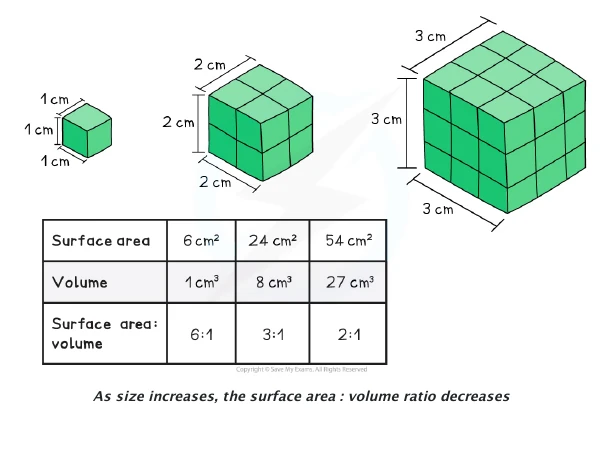
As an organism becomes larger, surface-area-to-volume ratio falls and diffusion distances increase, so specialised exchange surfaces and mass transport are required. Effective surfaces have large area, a thin barrier and mechanisms that maintain steep gradients.
Digestion and absorption
Amylase hydrolyses starch, membrane-bound disaccharidases release monosaccharides, endopeptidases and exopeptidases digest proteins, and lipase hydrolyses triglycerides. Bile salts emulsify lipid and form micelles.
Glucose and amino acids enter ileum cells using sodium co-transport. The sodium-potassium pump maintains a low intracellular sodium concentration. Lipid digestion products diffuse into cells and are reassembled before entering lacteals.
Gas exchange and mass transport
Countercurrent flow in fish gills maintains a diffusion gradient along each lamella. In insects, spiracles, tracheae and tracheoles deliver gases directly to tissues. Human alveoli combine ventilation, blood flow and a thin exchange barrier.
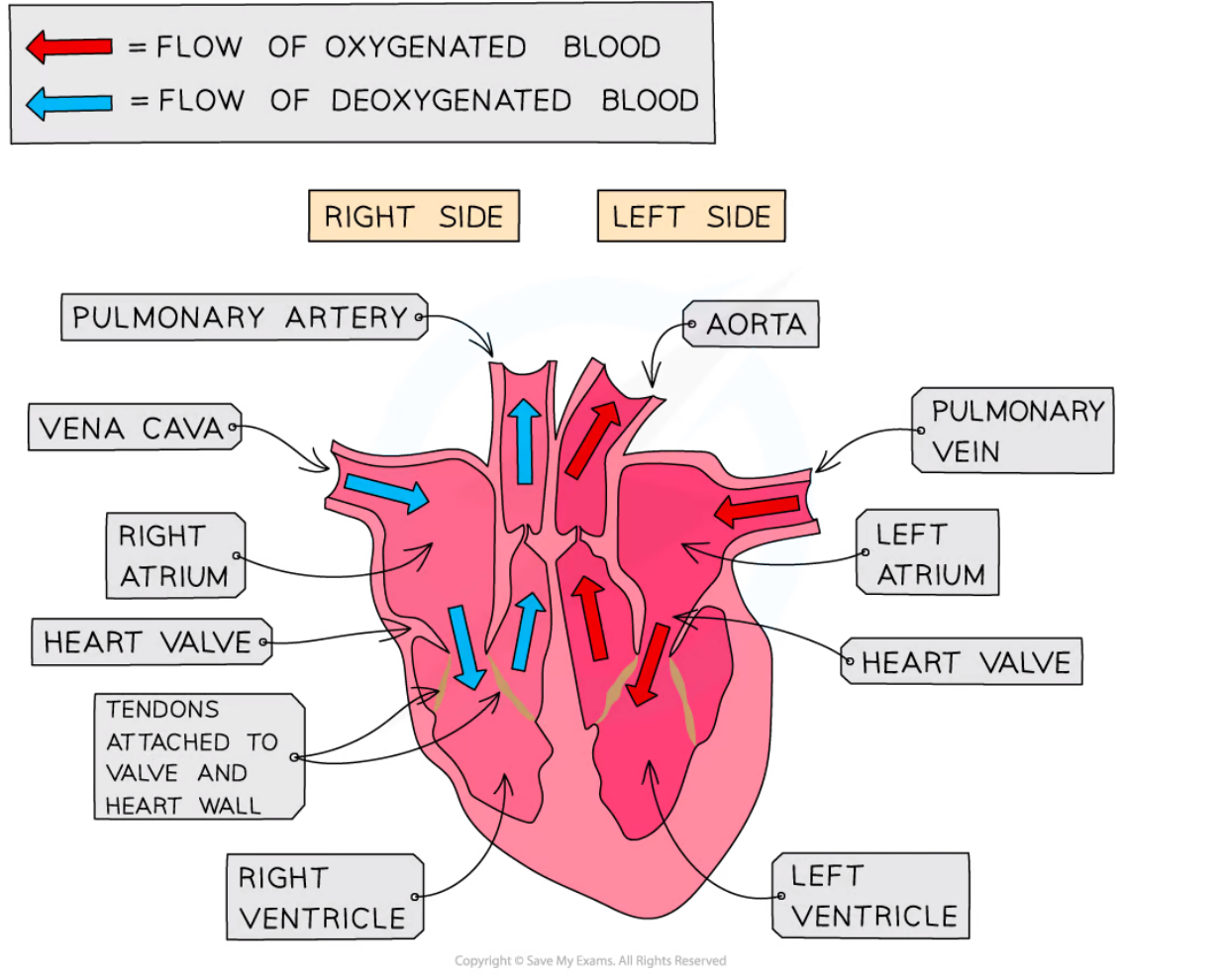
Plant xylem transports water by cohesion-tension; phloem translocates assimilates by mass flow. Mammalian double circulation maintains high systemic pressure, while haemoglobin loads and unloads oxygen cooperatively.
Human gas exchange, ventilation and disease
During inspiration, diaphragm contraction and external intercostal action increase thoracic volume; pressure falls and air enters. Ventilation refreshes alveolar air while blood flow removes oxygen, maintaining partial-pressure gradients. Pulmonary ventilation rate is tidal volume multiplied by breathing rate.
Smoking damages cilia, raises mucus production, exposes tissue to carcinogens and can contribute to emphysema as alveolar walls lose elastic support. When evaluating lung-disease data, quote the trend first, identify confounders and do not turn a correlation into a causal claim without supporting evidence.
Mass transport in animals and plants
A haemoglobin dissociation curve is sigmoid because oxygen binding is cooperative. Higher carbon dioxide lowers pH and shifts the curve right, improving unloading in active tissues. Cardiac output equals heart rate multiplied by stroke volume. Tissue fluid is formed by high capillary hydrostatic pressure and returns by osmosis or lymphatic drainage.
In plants, water evaporates from mesophyll then diffuses through stomata; cohesion and tension pull a continuous xylem column. At a phloem source, sucrose loading lowers water potential so water enters; high hydrostatic pressure drives mass flow to sinks. Potometers measure water uptake, not direct transpiration.
Active recall checkpoint
4Genetic Information, Variation and Relationships
From DNA to protein
A gene is a base sequence that codes for a polypeptide or functional RNA. During transcription RNA polymerase produces pre-mRNA; splicing removes introns. Ribosomes read mRNA codons and tRNA anticodons position amino acids for peptide-bond formation.
The genetic code is universal, non-overlapping and degenerate. Mutation can change amino-acid sequence and protein function, although degeneracy can make a substitution silent.
Genetic diversity and classification
Genetic diversity arises through mutation, meiosis and random fertilisation. Natural selection changes allele frequencies. Selective breeding and genetic bottlenecks can reduce diversity.
Classification is hierarchical; courtship behaviour, observable characteristics and molecular comparisons provide evidence of relationships. Differences in DNA or amino-acid sequences can be converted into phylogenetic trees.
Biodiversity and sampling
Species richness counts species; an index also includes evenness. Random quadrats reduce selection bias, transects examine gradients, and mark-release-recapture estimates mobile populations when assumptions are met.
Chromosomes, genes and protein synthesis
A chromosome is a DNA molecule associated with protein; a gene occupies a locus. Eukaryotic DNA is linear and associated with histones, whereas prokaryotic DNA is circular. Mitochondria and chloroplasts also contain DNA. Non-coding DNA can regulate expression, form introns or have structural roles.
Transcription makes RNA from a DNA template; eukaryotic pre-mRNA is spliced before translation. The genetic code is triplet, degenerate and nearly universal. Sequence comparisons between DNA, RNA or amino acids provide quantitative evidence for evolutionary relationships.
Meiosis, variation and natural selection
Meiosis halves chromosome number and creates variation through crossing over, independent segregation and random fertilisation. Mutations can affect a base sequence or chromosome number. Genetic diversity supports adaptation because selection can only act on heritable variation already present.
Natural selection raises the frequency of alleles associated with greater reproductive success. Directional selection shifts a population toward one extreme; stabilising selection favours the mean. Explain adaptation over generations, not as an individual responding because it needs a trait.
Diversity statistics and conservation
Species richness counts species; an index of diversity also reflects evenness. Random sampling, quadrats, transects and mark-release-recapture must suit the organism and habitat. Mean and standard deviation describe data; use a suitable statistical test only after checking what comparison or association is being tested.
Conservation methods include habitat management, legal protection, seed banks, captive breeding and agricultural choices that reduce loss of genetic diversity. Compare ecological effectiveness, cost, local communities, food production and long-term sustainability.